
15 Best Lead Generation Tools for Every Funnel Stage (2026)
Compare 15 lead generation tools by funnel stage, best fit and limitations. Use a fixed-sample test to choose the right stack for your team.
 14 min read
Short answer: there is no single “best” lead generation tool, because the phrase covers five different jobs: capturing visitors, finding prospects, verifying contact data, routing leads to the right rep and reaching out. Below are 15 tools worth shortlisting, grouped by the job they perform, with where each one holds up and where it does not. If you only read one section, read “How to Evaluate These Tools” and run the same fixed sample through your own shortlist before you sign a contract.
Author note: I’m Marharyta Sevostianenko, GTM & Content at Generect. I reviewed every vendor’s current scope against official sources on November 4, 2026. The selection method below is Generect’s framework; this edition does not claim that we ran a cross-vendor benchmark.
What “Lead Generation Tools” Actually Means
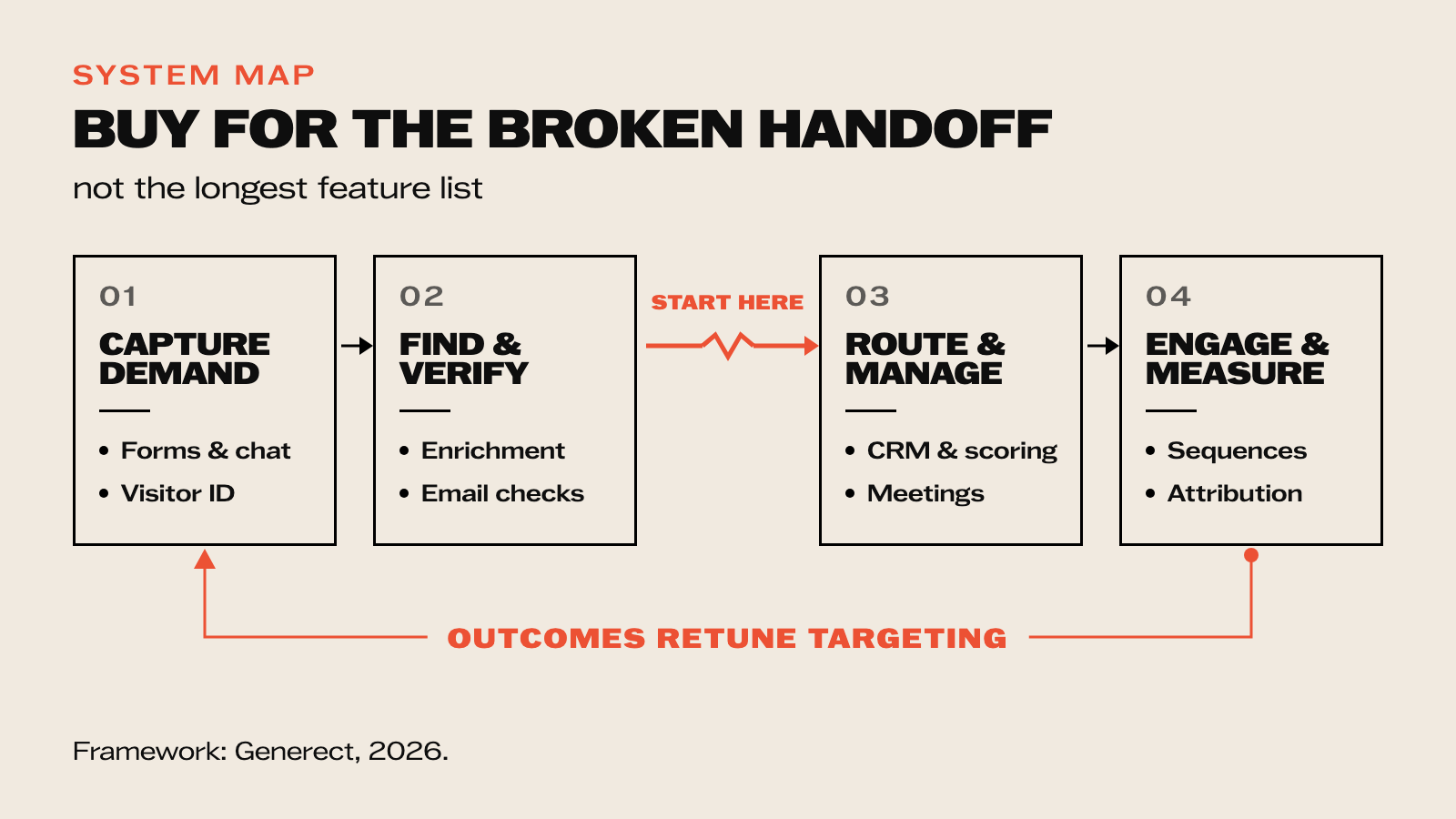
Search for “lead generation tools” and you get popup builders, B2B contact databases, email verifiers, CRMs and cold-email platforms all claiming the same keyword. They are not interchangeable. A popup builder captures a name and an email from someone already on your site. A contact database finds people who have never heard of you. A verifier checks whether the email you found still works. A CRM or routing layer decides which rep gets the lead. An outreach tool sends the first message. Buying the wrong one for the problem you have is the most common reason a “lead generation” line item sits unused by month three.
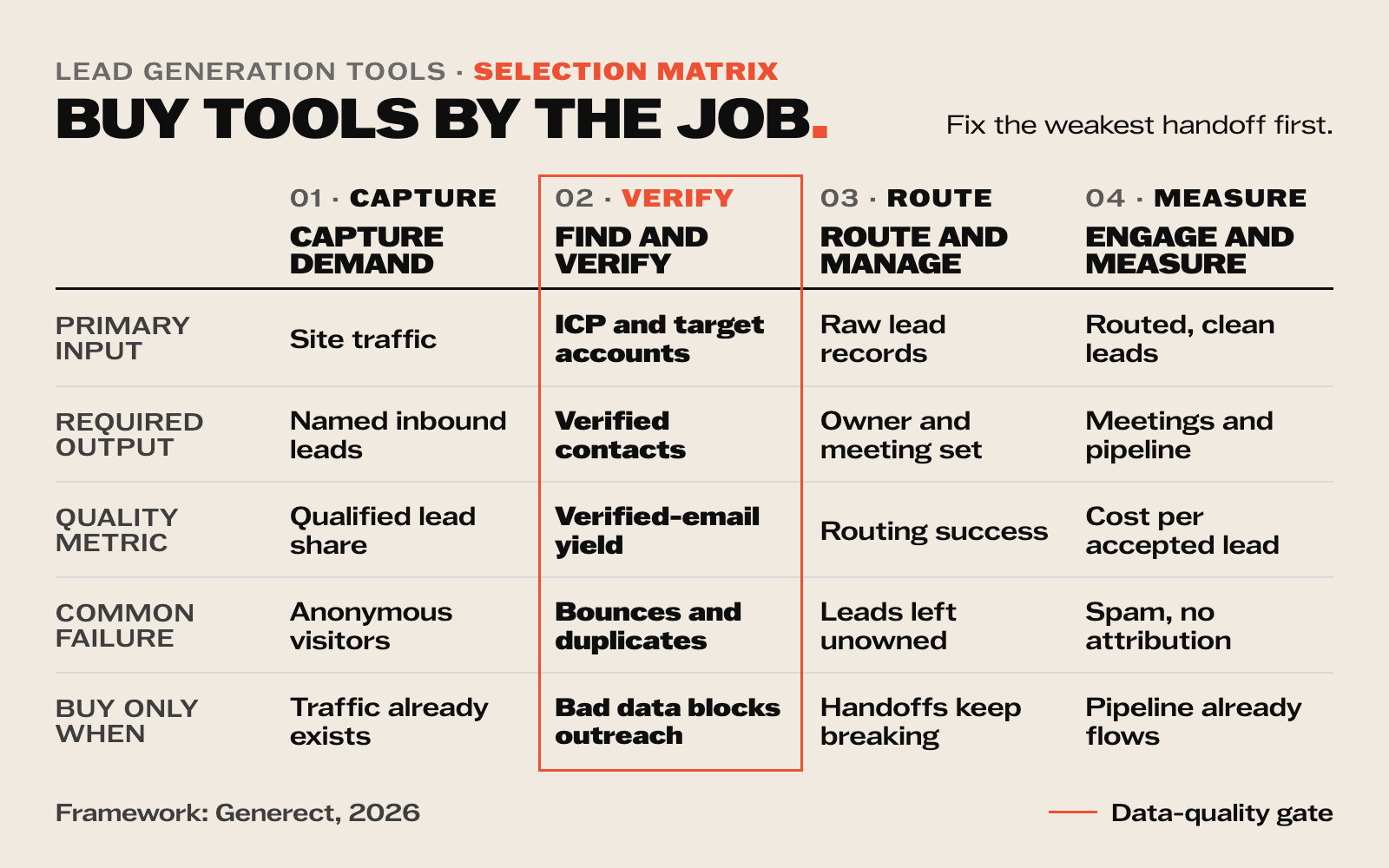
This guide splits the 15 tools into the five stages they solve: capture, prospecting and data, enrichment and verification, routing and CRM, and outreach. Read the stage that matches your current gap, not the one with the loudest marketing.
How to Evaluate These Tools (a Fixed-Sample Method You Can Reuse)
Vendor demos are built to look good on the vendor’s own sample data. The only comparison that means anything uses your data, held constant across every tool you test.
- Freeze one sample. Pull a real list from your own CRM or ICP definition: 50 target companies and 100 target contacts (the job titles you sell to). Do not change this list between tools.
- Run the same sample through every candidate. For capture tools, that means the same test form submission or chat flow. For data and prospecting tools, search for the same 50 companies and the same titles. For verification tools, feed in the same 100 email addresses.
- Score four things, not the vendor’s claimed numbers. Match rate (what share of your 100 target contacts the tool returned), field accuracy (manually review a random 10% against current company pages, then validate addresses before any permitted outreach and record the bounce or dead-number rate from your normal workflow), time to a usable list (minutes from signup to a file you could load into outreach today), and price per contact that passed verification, not the vendor’s advertised database size.
- Keep one shared spreadsheet across all 15 tools. The same ICP, the same list and the same four scores turn fifteen separate vendor calls into one decision you can defend.
This method also protects you from a trap specific to this category: a tool can have a huge headline database and still return a thin result for your specific ICP, because coverage is never evenly distributed across industries and regions.
15 Lead Generation Tools at a Glance
| Tool | Category | Best for | Where it’s limited |
|---|---|---|---|
| OptinMonster | Capture | Exit-intent popups and on-site A/B testing on WordPress and standard CMS sites | Captures the lead only; no storage, scoring or routing |
| HubSpot Marketing Hub | Capture | Forms and live chat tied to the same contact record as the CRM | Advanced personalization sits behind paid tiers |
| Drift (by Salesloft) | Capture | AI conversational capture and meeting booking on enterprise sites | Part of Salesloft after the 2024 acquisition, so buyers should confirm current packaging and fit |
| Apollo.io | Prospecting and data | Search, enrichment, sequencing and a dialer in one seat-priced platform | Per-user pricing can grow as more reps are added |
| ZoomInfo | Prospecting and data | Enterprise GTM intelligence spanning data, intent and orchestration | Priced and packaged for enterprise contracts |
| Cognism | Prospecting and data | Compliance-first EMEA data with Do-Not-Call coverage for cold calling | Sales-led purchasing, so buyers should confirm current trial and contract terms |
| Generect | Prospecting / Enrichment / Verification (data layer) | Verified contacts pulled in real time instead of resold from a static export | Data layer only: no built-in CRM or sequencer |
| HubSpot Breeze Intelligence | Enrichment and verification | Firmographic enrichment inside an existing HubSpot CRM record | Locked to HubSpot since the 2024 rebrand; no cross-CRM use |
| ZeroBounce | Enrichment and verification | A dedicated bulk verification pass before a large send | Verifies only; does not find or enrich contacts |
| Salesforce Sales Cloud | Routing and CRM | Fully customizable lead-to-opportunity routing at scale | Setup and admin overhead usually need a dedicated admin |
| HubSpot CRM | Routing and CRM | A free CRM core with workflow-based routing for small to mid-size teams | Simpler routing logic than Salesforce; advanced automation is paid |
| LeanData | Routing and CRM | Lead-to-account matching and buying-group routing for Salesforce-native teams | Built around Salesforce; most value only if you already run it |
| Outreach.io | Outreach | AI-assisted multichannel sequencing with conversation intelligence and forecasting | Enterprise-scale pricing and onboarding, not quick self-serve |
| Instantly | Outreach | Cold email sending plus a built-in B2B lead database and simple CRM | Deliverability still depends on your own domain warm-up |
| lemlist | Outreach | Multichannel sequences (email, LinkedIn, calls) with basic lead scoring | Deeper reporting and dedicated IPs sit in the Enterprise tier |
Capture: Turning Anonymous Visitors into Leads
Capture tools convert someone already on your site, in your chat widget or on your landing page into a named contact. This is the stage most people picture first, and the one with the least room to be wrong for long: a broken popup or a dead chat flow quietly loses leads every day without ever showing up as an error.
| Tool | Best for | Limitation |
|---|---|---|
| OptinMonster | Exit-intent popups, scroll boxes and on-site A/B testing without a dev team | Captures the lead only; you still need a CRM and a list-growth stack downstream |
| HubSpot Marketing Hub (forms and live chat) | Teams already on HubSpot who want forms and chat tied to the same contact record that becomes a deal later | Advanced targeting and automation depend on the current HubSpot tier |
| Drift (by Salesloft) | Enterprise sites that want AI-driven conversational capture and meeting booking from the chat widget | Since Salesloft acquired Drift in 2024, buyers should evaluate it as part of Salesloft’s current platform and confirm packaging directly |
Prospecting and Data: Finding the Right People
Once the inbound trickle is not enough, you need to go find people who have never visited your site. This is where most of the category’s marketing budget gets spent, and where “database size” is the most overused and least useful number on a pricing page: a huge total index does not tell you how many of your specific target titles, in your specific target industry, it covers.
| Tool | Best for | Limitation |
|---|---|---|
| Apollo.io | Teams that want search, enrichment, sequencing and a dialer in one seat-priced platform, with a usable free plan to start | Paid plans use per-user packaging, so cost can grow as more reps are added (current plans) |
| ZoomInfo | Enterprise revenue teams that want one GTM platform spanning sales intelligence, intent data and orchestration | Priced and packaged for enterprise contracts, rarely the first stop on a monthly budget |
| Cognism | EMEA-focused teams that need compliance-first data with strong Do-Not-Call coverage for cold calling programs | Purchasing is sales-led; confirm current trial access and contract terms on Cognism’s site |
| Generect | Teams that want a contact searched and verified the moment they need it, instead of licensing a static export that goes stale between refreshes (full write-up below) | No CRM or sequencer built in; see Enrichment and Verification |
Generect’s own B2B lead generation tool page frames it as a search engine rather than a database you license once, which is also why it shows up in this section and the next one.
Enrichment and Verification: Making Contacts Usable
A name and a guessed email are not a usable lead. This stage checks whether the contact data you sourced (from any tool above, including your own CRM) is deliverable before a rep spends time on it or a sender domain takes the reputation hit of a bounce.
| Tool | Best for | Limitation |
|---|---|---|
| Generect | Real-time email and phone verification at the point of search | Data layer only, not a CRM or sequencer |
| HubSpot Breeze Intelligence (formerly Clearbit) | Firmographic enrichment and website-visitor identification inside an existing HubSpot record | Designed for HubSpot workflows after the 2024 Breeze Intelligence launch, not cross-CRM use |
| ZeroBounce | A dedicated bulk verification pass before a big send, independent of whichever tool sourced the list | Verifies only; does not find or enrich contacts, so it is a companion tool rather than a sourcing tool |
Generect, specifically, as a data layer: Generect positions itself as a real-time B2B lead search engine that pulls verified contacts on demand instead of reselling a static, aging database. On verified records, it reports 98% email validity and 98% phone accuracy, with data fetched live rather than resold from a stale export. In practice that means its AI email finder and email verification run at the moment you pull a contact, not months earlier when some other company last licensed the record. Teams that want this checked programmatically can do it through the Generect API instead of the web interface. Generect was also one of 35 companies selected for Google for Startups, which came with Google Cloud credits and mentorship, a reasonable signal of technical credibility if you are evaluating it against a less transparent vendor.
The honest limitation is simple: Generect is a data layer, not a CRM and not an outbound sequencer. It does not replace the Routing and CRM tools or the Outreach tools below; it feeds them with contacts that have already been verified rather than guessed. As of November 4, 2026, the live Generect pricing page lists search and filters as free, a valid email at $0.03, an exported record at $0.02 and a phone number at $0.40. Pay as you go starts at $20 with no subscription or seat fee. Buyers should recheck the live page because usage rates can change. If you are coming from a seat-priced database, see Generect vs Apollo for how the two models compare on the same job.
Worked usage-cost example: using those live rates, 100 valid emails cost $3 and exporting the same 100 records costs $2. Adding phone numbers for 20 of those contacts adds $8, so the usage total is $13 before any Spend & Save discount or taxes. This is pricing arithmetic, not a performance benchmark; the test above still decides whether those 100 records fit your ICP.
Routing and CRM: Getting Leads to the Right Rep Fast
A verified lead that sits in a shared inbox for two days is close to a dead lead. This stage decides who owns it the moment it arrives, and how it is tracked once a rep starts working it.
| Tool | Best for | Limitation |
|---|---|---|
| Salesforce Sales Cloud | Larger sales orgs that need fully customizable lead-to-opportunity routing, assignment rules and reporting at scale | That flexibility comes with real setup and admin overhead, usually a dedicated Salesforce admin |
| HubSpot CRM | Small to mid-size teams that want a free CRM core with workflow-based routing and the capture tools above in one system | Routing logic is simpler than Salesforce’s, and deeper automation sits behind paid tiers |
| LeanData | Salesforce-native teams that need precise lead-to-account matching, buying-group routing and SLA enforcement across a complex territory model | Built around Salesforce, so it adds the most value only if you already run that CRM; its own current positioning has broadened toward AI GTM orchestration rather than routing alone |
Outreach: Turning Leads into Conversations
Once a lead is captured, verified and routed, someone (or something) has to send the first message. This stage lives or dies on sending discipline and list quality, not on the sequencer’s feature list.
| Tool | Best for | Limitation |
|---|---|---|
| Outreach.io | Enterprise sales teams that want AI-assisted multichannel sequencing bundled with conversation intelligence, deal management and forecasting | Enterprise-scale pricing and onboarding, not a quick self-serve setup |
| Instantly | Outbound teams that want cold email sending plus a built-in B2B lead database and simple CRM in one subscription | Deliverability still depends on your own domain warm-up and sending discipline; no tool fixes a burned domain |
| lemlist | Small outbound teams that want multichannel sequences across email, LinkedIn and calls plus basic lead scoring without stitching together three tools | Confirm whether the current plan includes the reporting and sending controls your team needs |
A Concrete Stack Example: Seed-Stage B2B SaaS, Two AEs, No RevOps
A small team does not need five enterprise contracts running at once. Here is one combination that keeps cost proportional to actual usage instead of seats:
- Capture: OptinMonster on the marketing site, set to trigger an exit-intent popup for a demo request, feeding directly into the CRM below.
- Prospecting and data layer: Generect to pull verified contacts for a defined ICP (industry, headcount band, title) the moment a rep needs a new list, instead of paying for a seat-priced database that goes stale between quarterly refreshes. Contacts run through Generect’s email finder and verification before they ever enter the CRM, so the CRM never fills up with guessed addresses.
- Routing and CRM: HubSpot CRM (free or Starter tier), with simple round-robin assignment between the two AEs since there is no territory model yet.
- Outreach: Instantly for the actual cold email sequencing, since it already includes basic lead-database backfill and the team does not need Outreach.io’s enterprise forecasting at this stage.
The logic behind this specific combination: keep data acquisition usage-based (Generect) rather than seat-based (a full database license) while the team is still small and the ICP is still being refined, and only move to seat-priced or enterprise tools once the volume justifies the fixed cost. Generect’s role in this stack is strictly the data layer; it is not doing the job of the CRM or the sender.
Frequently Asked Questions
A lead generation tool is any software that helps a business find, capture or qualify potential customers, from an on-site popup that captures an email address to a search engine that returns verified phone numbers for a target account list.
A lead generation tool finds, captures or verifies contacts. A CRM stores those contacts, tracks the relationship and manages the deal once a rep starts working it. Most teams need both, since a search engine like Generect or a capture tool like OptinMonster is not built to track pipeline stages or forecast revenue.
Pricing varies by category, from free self-serve plans on capture tools and entry-tier CRMs to quote-only enterprise contracts on tools like Cognism, ZoomInfo and Outreach.io. Check each vendor’s current pricing page rather than relying on a single number, since per-seat and usage-based models are not directly comparable.
A startup usually needs a capture tool with a free tier, a usage-based data layer instead of a seat-priced database, a free or low-cost CRM and one outreach tool, not five enterprise contracts at once. See the stack example above for one concrete combination.
Only if you want a second, independent check before a large send. Every prospecting tool validates at the moment of search, but email addresses go stale between the search and the send, especially on longer sales cycles.
No. Generect is a data layer that finds and verifies B2B contacts in real time. It pairs with whichever CRM and sequencer you already run rather than replacing either one.
Run the same fixed sample of target companies and contacts through each tool’s trial, score match rate, field accuracy and time to a usable list on that one sample, and compare the results instead of trusting any vendor’s advertised accuracy number.
None of these 15 tools do all five jobs well, and any vendor claiming otherwise is describing a roadmap, not a product. Pick the stage you are missing, run the fixed-sample test above against two or three candidates for that stage, and add the next stage once the current one is working.