

925 UK coworking operators no B2B database could filter for
No B2B database knows which software a coworking space runs on. How we built Spacebring 925 qualified UK operators in three working days, with 82.7% recall against their own list.
 9 min read
Spacebring is a platform for managing coworking spaces, built to help administrators give their members better service. Their buyers are coworking operators, and in August 2026 they asked us for a list of UK operators with one column no data vendor sells: which software each space already runs on, if any.
Three working days later they had 925 qualified operators, built from 3,214 companies, with the evidence for every column. The other half of the story runs inside their CRM: each demo request that lands in Attio is enriched by Generect before the team gets the notification.
This is how both halves work, with the numbers we checked before publishing them. Igor Dzhebyan-Benjamin, CEO and co-founder of Spacebring, tells his side in the video.
The column no filter has
“As a coworking space management platform, as you can imagine, we are a pretty niche product,” Igor says. “There are certain attributes of our potential customer that are not so easy to find in those generalist lead finding tools.”

Three attributes decide whether a space is worth a call for Spacebring:
- The platform it runs on. Spacebring, a competitor, or nothing at all.
- Whether the website takes bookings. A space that books meeting rooms through a contact form feels the pain Spacebring removes.
- The quality of its online presence. In Igor’s words, it “speaks volumes to whether they could be potentially an adopter of our platform or not.”
A B2B database files a four-person coworking in Bristol as real estate with 2 to 10 employees, the same as the letting agency next door. Industry, headcount and location are all there. How the space takes a booking is not a field anywhere, so no filter can return it. The only place that answer exists is the operator’s own website.
How we built the list
When the defining attribute is not a filter, the universe has to come from where the companies physically exist, and the attribute has to be read from their sites. That took five steps.
1. Start from the map, not from a database
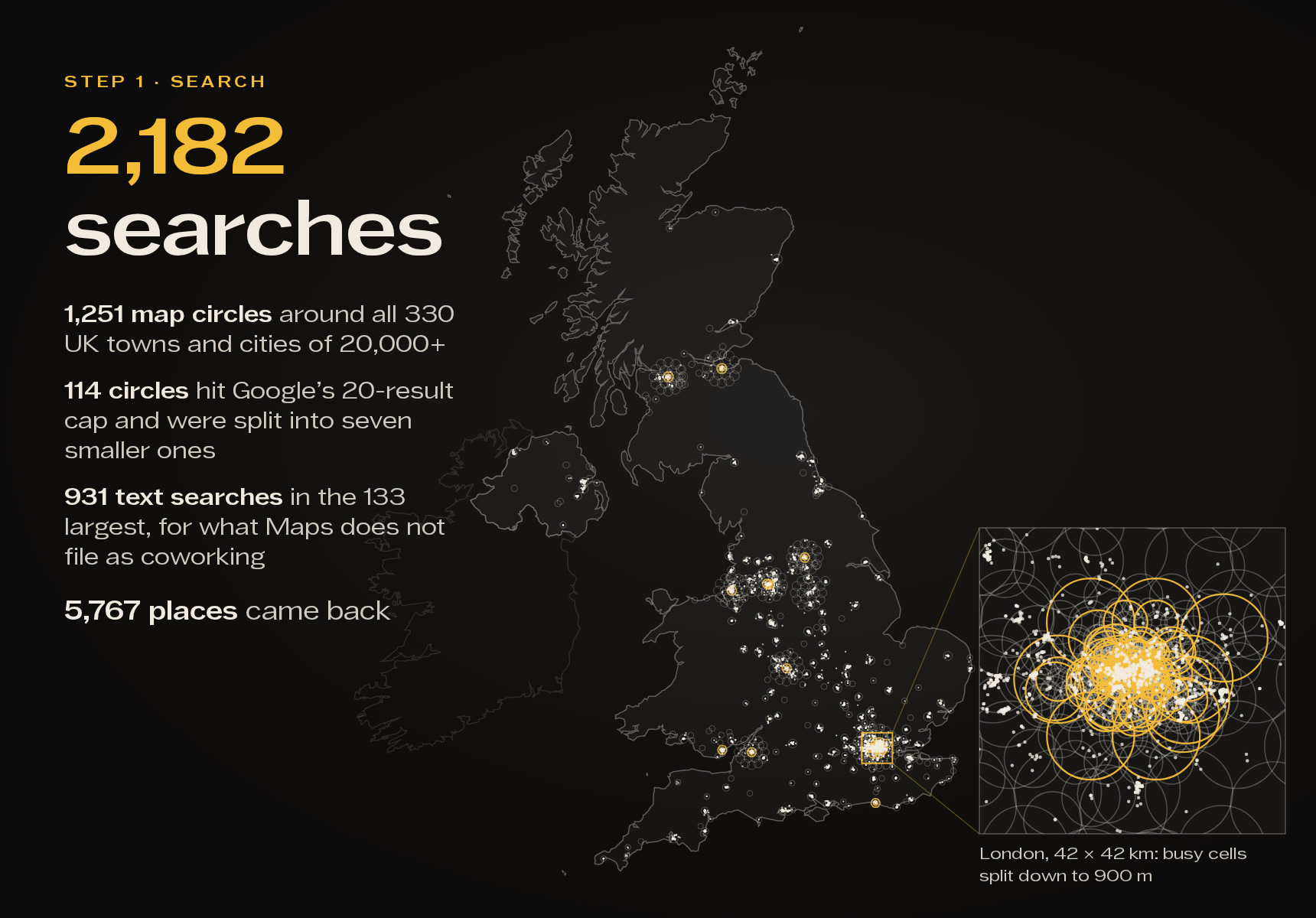
We ran Google Places over an adaptive grid covering all 330 UK towns and cities with 20,000 or more residents, with denser tiling in the big cities where a single query stops at 20 results. Places types many serviced-office operators as real estate agencies, so a second pass searched by phrasing (“serviced office”, “flex office”, “business centre”) without the type restriction.
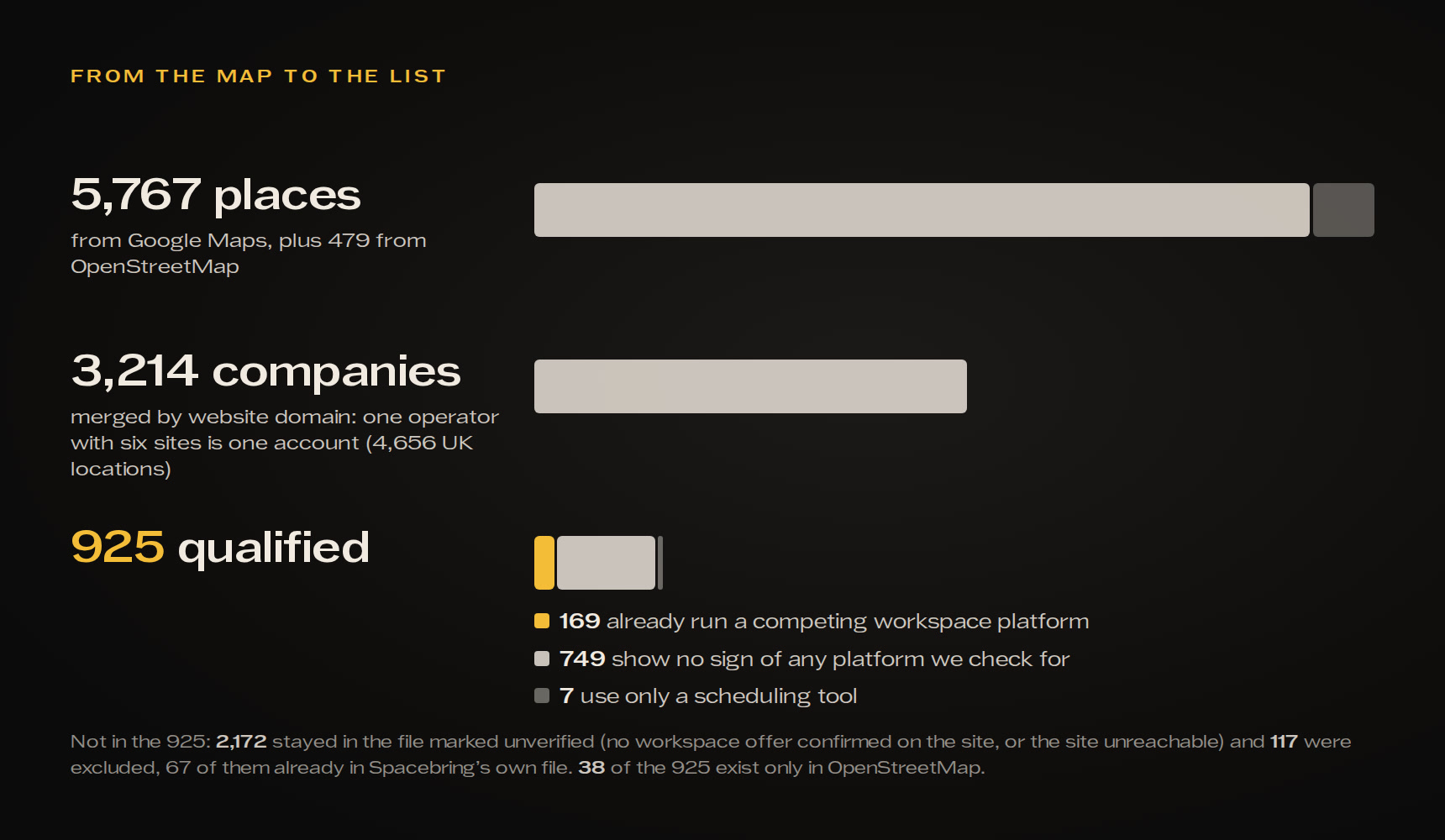
The two passes came to 2,182 searches and returned 5,767 places. OpenStreetMap added another 479. Merged by website domain, they became 3,214 companies with 4,656 UK locations, because one operator with six sites is one account. The second source paid off: 38 of the operators that finally qualified exist only in OpenStreetMap.
2. Read every website
For each company we crawled the home page and then went looking for the pages that give the operating model away: booking, login, members and pricing. Small coworking sites often sit behind aggressive firewalls, so any site that refused a plain request got a second attempt with a browser-like client.
3. Detect the platform from what the site loads
Workspace platforms leave fingerprints. A member portal on the vendor’s subdomain names the tenant. A booking widget loads the vendor’s script. A member app in the app stores carries a package id with the vendor’s name in it. We check for over two dozen workspace and booking platforms this way, plus the payment, form and chat tools around them.
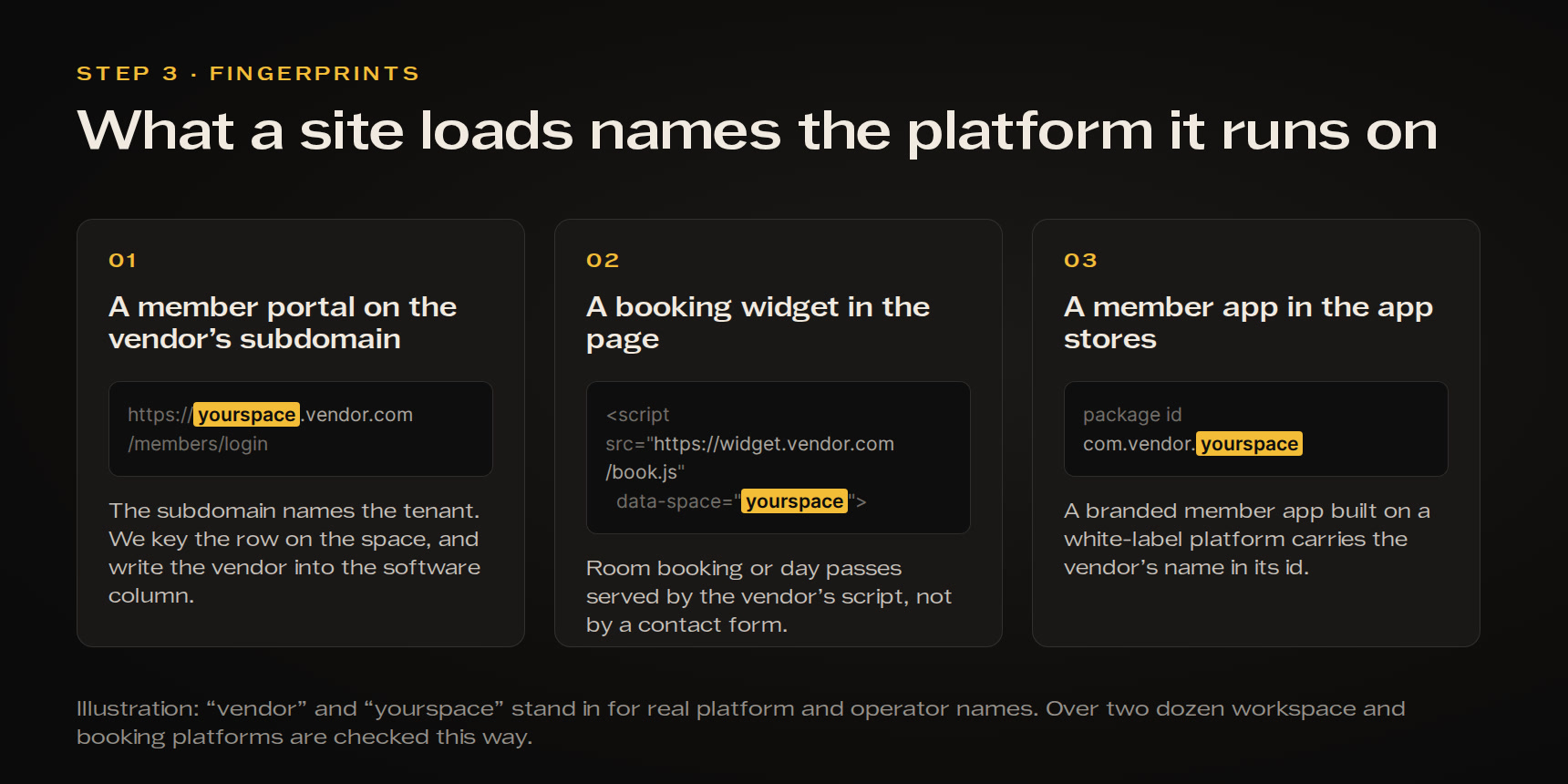
Igor flagged one trap in the brief: some spaces run their whole website on a competitor’s subdomain, and a naive crawler would collapse that to the vendor’s own domain and hand him the vendor’s sales team as leads. We key every such site on the tenant, never on the vendor, and write the vendor into the software column instead.
4. Qualify the workspace
Maps and keyword searches also return letting agents and landlords. Each site was scored on workspace evidence (hot desks, meeting rooms, private offices, membership pricing, day passes) against letting language (“to let”, “leasehold”). Sites that did not confirm a real workspace offer did not make the qualified list: they stayed in the file in a separate unverified tier, so nothing was thrown away silently.
5. Find the people
Spacebring’s own research file showed who they write to, so the contacts came in two groups: the owner who signs (founder, managing director, CEO) and the person who feels the pain daily (community, operations or centre manager). The company LinkedIn page came from the operator’s own website footer rather than a fuzzy name search, which is cheaper and does not pull in strangers with a similar name. For micro-operators where nobody has a LinkedIn profile, the file carries the role inbox from the website, clearly marked as such.
What came back
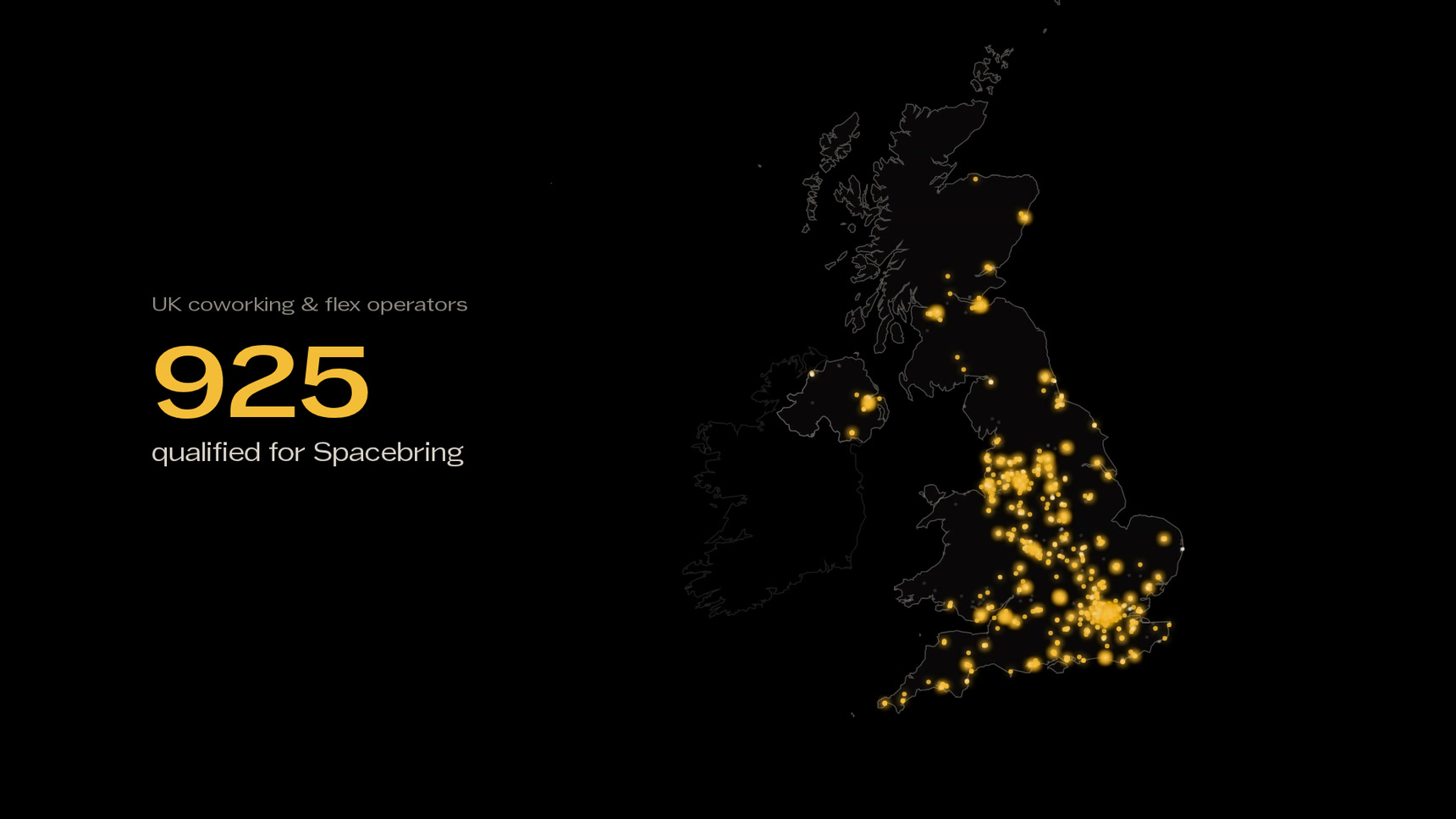
- 925 qualified operators out of 3,214 companies.
- 169 already run a competing workspace platform, with the platform named and the link that proves it.
- 749 showed no sign of any of the platforms we check for. For Spacebring that is the greenfield: spaces still running bookings by hand.
- Every attribute a filter cannot produce arrives with its source URL, so any row can be checked in one click.
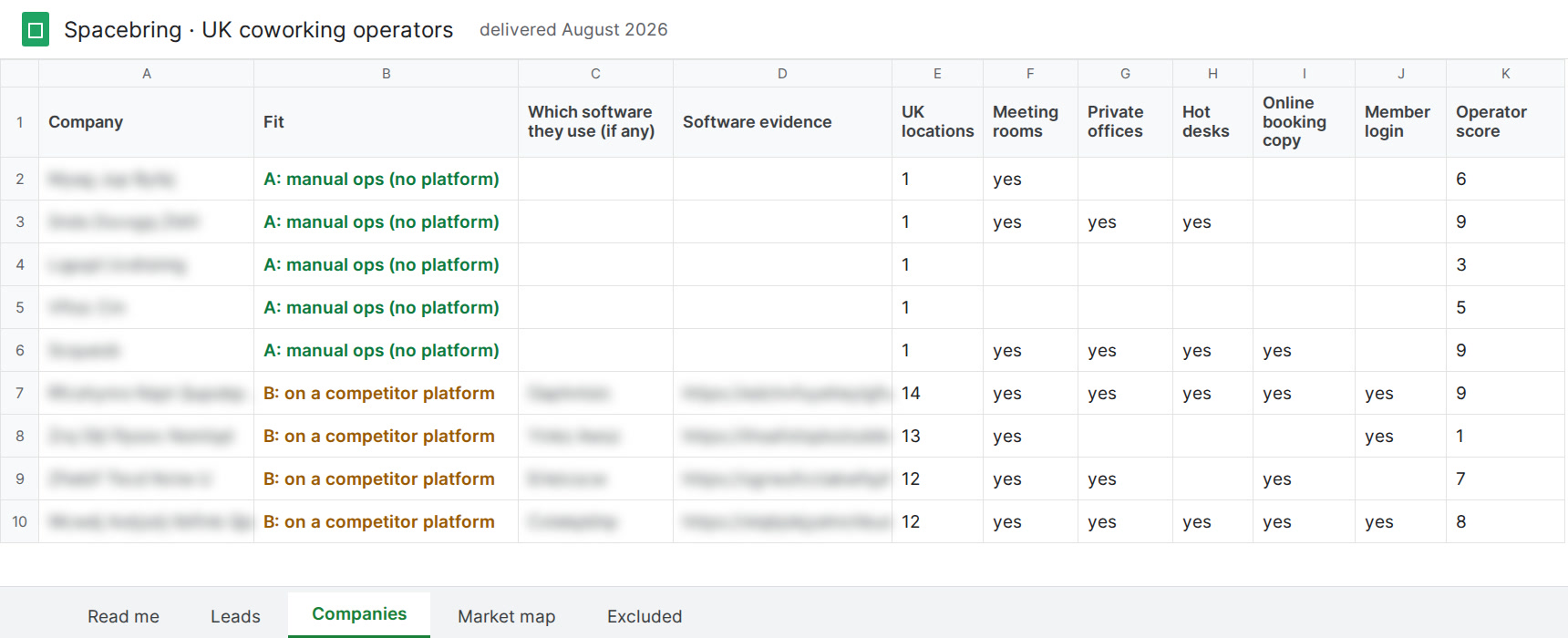
“Honestly, I thought there will be maybe 100 contacts, or 200. I got over 500,” Igor says. “I didn’t even know there’s so many contacts in the industry.”
Need a column no database has?
Tell us the attribute that defines your buyer. We build the list from where the companies are, and measure it against a list you trust before delivery.
How we measured it before sending
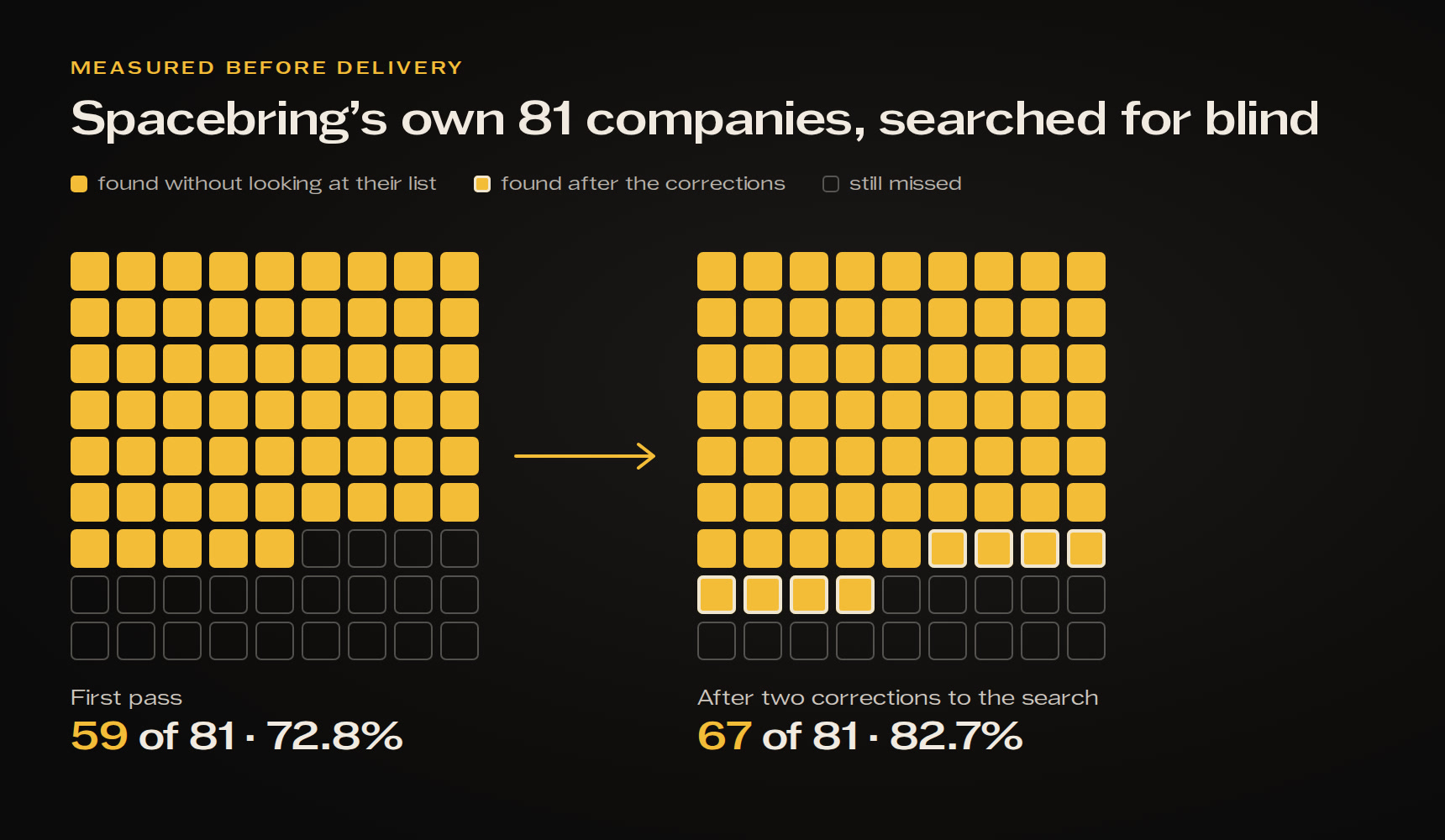
“We got a lot of contacts” is not a quality measure. Spacebring had attached their own research file to the brief: 81 companies they had already looked at. Instead of only removing those from the delivery, we used them as ground truth. We ran the search without looking at their list and counted how many of their 81 companies we had found on our own.
The first pass found 59 of 81, a recall of 72.8%. The misses explained themselves: most were serviced-office operators that Places files as real estate, which is what the untyped text pass then fixed. After two corrections to the search, we found 67 of 81, or 82.7%. That number went into the delivery note before anyone asked for it.
The same check caught a quieter problem. Spacebring’s file marked one space as running on a particular platform, and our detector saw nothing. The pattern matched the vendor’s .com domain, while UK tenants sit on its .co.uk. After making every vendor pattern domain-agnostic, and adding two platforms that a scan of unknown booking hosts turned up, five companies moved from “no platform” to “on a platform”. Without the fix we would have sold them as greenfield.
Spacebring ran their own test too. “Well, we didn’t know at first, so we tested. We tried ourselves. We validated the contacts,” Igor says. “With the data that we got from Generect, we got abnormally low bounce rates. We got actual replies, and even demos booked from this data.”
The second half: enrichment inside Attio
The list fills the top of the funnel. The other half of the case is about the leads that come in on their own.
“In our sales process, customers would normally book a demo with us through our website,” Igor says. “And oftentimes, as you can imagine, they could book it with a Gmail or a company email that we have no idea who they are.” Asking for more on the form is not an option: “every field we add there hurts conversion.”
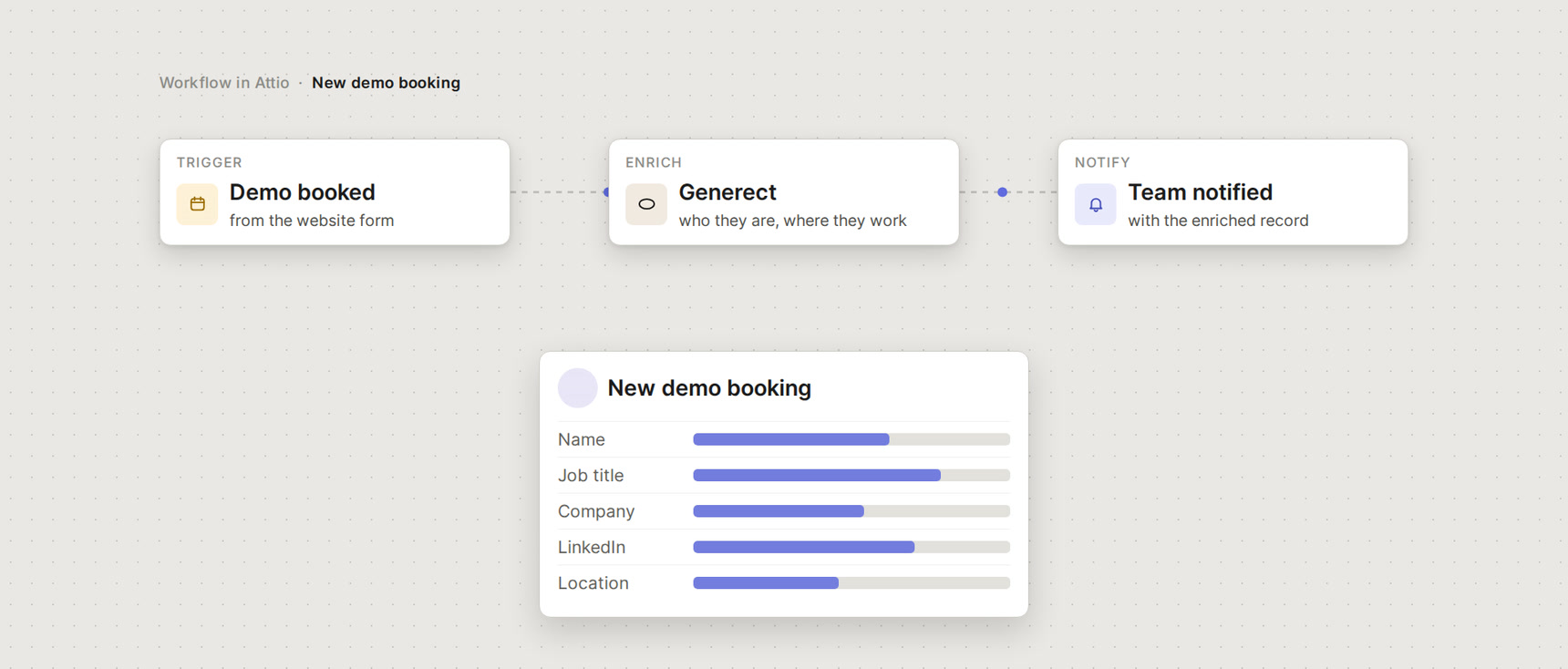
So the form stays short and the CRM does the work. When a demo is booked, an Attio workflow sends the new record to Generect, Generect fills in who the person is and where they work, and the team gets a notification with the enriched record. “It’s set up at the account level, so each of my administrators doesn’t really need to do their own setup. It’s just all centralized, simple, and just works.”

“Honestly, Generect is the only data enrichment that I found that actually works,” Igor says.
If you sell to a niche
Three things from this project carry over to any market where the buyer is defined by something a database does not index:
- Build the universe from where the companies exist. Maps, registries and directories, then read each company’s own website for the attribute that matters.
- Measure recall against a list you already trust. If a vendor cannot tell you what share of your known accounts they found blind, you are judging the list by its length.
- Ask for evidence on every attribute that is not a filter. A checkbox you cannot verify is a guess with a nice format.
The time it took on Spacebring’s side was small. “It took me probably minutes to explain to Generect team what I need to find and what are the attributes. They really understood me fast,” Igor says. “The guys are just picking it up and delivering.”

Your buyer has a column no filter can produce?
Book a call and tell us what it is. Or try enrichment on your own data first: new accounts start with free credits.