


Choosing a B2B lead source used to feel simple: grab a list, start outreach, hope for the best. But over the years, as I’ve tested different tools, burned hours on stale data, and watched sales reps chase dead-end leads, I’ve learned that the right lead source can make or break your pipeline.
In 2026, the stakes are even higher. Buyer journeys are scattered across channels, privacy regulations keep tightening, and hybrid teams need accurate data they can trust. Pick the wrong platform, and you’re stuck with bad info, confusing pricing, and clunky workflows that slow everything down.
That’s why comparing platforms like ZoomInfo and UpLead really matters. Beyond big feature lists, what you actually need is accuracy, intent signals, smart automation, and a tool that fits naturally into how your team works.
And there’s also a newer option worth considering: Generect. It takes a fresh approach with real-time verification, pay-as-you-go pricing, and functioning as an automated lead generation system with enrichment – perfect if you’re tired of long contracts.
In this guide, I’ll walk you through what truly matters when picking a lead source in 2026:
- Reliable, up-to-date data
- Enrichment and intent features
- Transparent pricing
- Easy integrations
- A workflow your team won’t fight against
Yet, before Uplead vs Zoominfo B2B lead generation comparison, you need to know what these tools actually do.
Let’s start with a quick, no-fluff look at each platform so you can see where they fit in your workflow.
What are ZoomInfo and UpLead?
If you’re diving into B2B lead generation tools, you’ll often hear ZoomInfo and UpLead mentioned as top contenders. Both are powerful but serve different needs, and understanding what sets them apart helps you pick the right one.
Let’s start with UpLead.
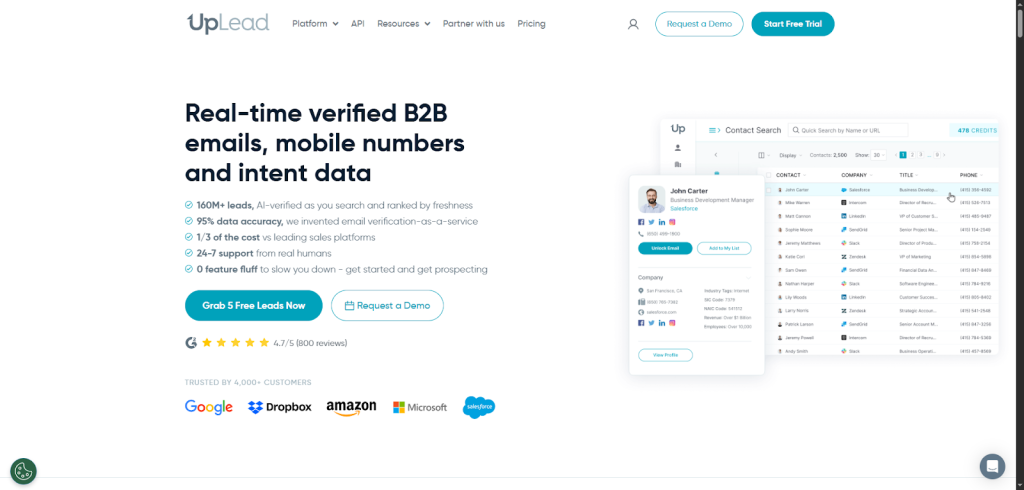
Think of it as your go-to lead intelligence software aimed at delivering real-time verified emails with a sharp accuracy rate of 95%. With over 160 million contacts and more than 50 filters, it’s especially popular among SMBs and mid-market companies.
UpLead’s interface is clean and easy to use, meaning you don’t waste time figuring out complicated menus. It shines with features like technographics and buyer intent, and tools such as the prospector and email finder make hunting down the right leads pretty straightforward.
Their data mainly comes from public records and licensed vendors, which explains their consistent accuracy. If your sales cycles vary month-to-month, you’ll appreciate UpLead’s credit consumption model – buy what you need, when you need it.
In contrast, ZoomInfo targets larger enterprises with a robust go-to-market intelligence platform.
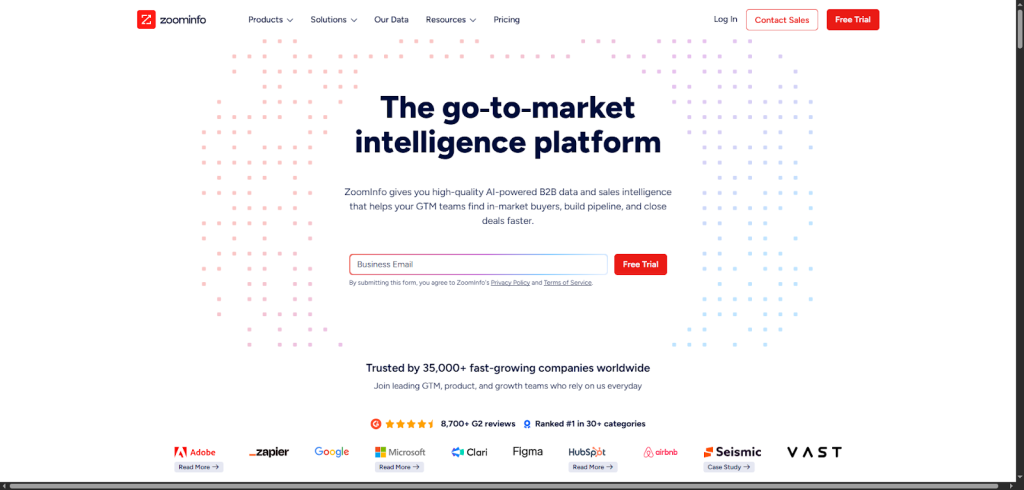
Imagine 250 million contacts combined with deep company insights, AI-driven data refinement, and intent data covering over 4,000 topics.
It’s got modules like SalesOS, MarketingOS, and TalentOS to cover all angles of sales, marketing, and recruitment. ZoomInfo operates like an all-in-one ecosystem, mixing data, automation, and engagement workflows seamlessly.
It has a 300+ strong research team constantly updating proprietary data. While it’s more complex, if you want advanced features and expansive market reach (especially in tech and financial services), you’re in good hands.
Before wrapping up, it’s worth mentioning Generect, a next-gen lead search engine gaining traction for its speed and 98% verified contact validity. It’s perfect if you want real-time data freshness plus a simple pay-as-you-go pricing model.
Its user-friendly design caters perfectly to founders and sales teams looking for agility rather than heavyweight enterprise features.
So, here’s a quick look to sum up what you get:
- UpLead → best for SMBs, high accuracy, easy interface, 160M+ contacts, flexible credit model
- ZoomInfo → enterprise focus, huge database, advanced AI, broad intent coverage, all-in-one platform
- Generect → real-time, pay-as-you-go, 98% accuracy, API-friendly, startup and agency-friendly
Now that you know the basics, it’s time to see what you actually get. We’ll break down ZoomInfo vs Uplead features so you can spot the strengths that matter most for your daily work.
Stop guessing. Start finding hot leads live.
Generect pulls and verifies leads the moment you search—no stale info, no surprises. Perfect if accuracy is your bottleneck.
What features do ZoomInfo and UpLead offer?
When you’re hunting for the best lead source in 2026, knowing what features ZoomInfo and UpLead bring to the table is a game-changer.
Here, in this section, you’ll learn how these platforms stack up in database size, search tricks, verification, automation, integrations, and usability. Plus a fresh look at Generect, a rising star in the field.
Let’s dive in.
Database size and scope
ZoomInfo boasts a massive contact list, ranging roughly between 250 to 321 million contacts. It’s one of the largest pools out there. Company profiles are equally comprehensive, covering a wide range of industries and global regions, from North America and Europe to emerging markets.
If you want a quick sense of what this scale actually means for your day-to-day, here’s the practical breakdown:
- More reachable prospects in your ICP without endless filtering
- Better coverage across roles, especially hard-to-find titles
- Faster list-building for campaigns and outbound sequences
- Higher chances of multithreading within target accounts
- Global reach if you’re selling beyond your domestic market
ZoomInfo shines if you want depth in tech, healthcare, finance, and manufacturing, with detailed org charts and comprehensive company insights.
UpLead, meanwhile, offers a solid 160 million contacts. It’s smaller but sharp. Its database covers many industries worldwide and is praised for clean, accurate company profiles.
While its regional coverage isn’t as broad as ZoomInfo’s, UpLead stays competitive by constantly refining data quality, focusing on high-value markets.
Search and filtering capabilities
Now, here’s where both platforms get interesting. UpLead provides 50+ filters, including technographics, industry, job title, company size, and more. You can slice and dice data easily. The filter options are practical and straightforward, so combining multiple filters is a breeze.
Plus, you can save your searches and revisit hot lead lists without starting from scratch. What UpLead’s filtering power means for you:
- Faster targeting of your exact ICP
- Cleaner lists with less manual cleanup
- Easier A/B testing for different outbound angles
- Quick access to saved high-performing segments
- More precise campaigns with multi-layered filters that actually work
ZoomInfo, on the other hand, goes hardcore with advanced Boolean search options, letting you create complex queries that pinpoint prospects with precision. Their org charts reveal reporting structures, while funding and location filters give you more nuanced angles.
If you like sophisticated, granular searches = ZoomInfo has your back.
For instance, if you want Software Engineers using specific technologies in mid-sized companies in Berlin, ZoomInfo can deliver with exact parameters. UpLead simplifies this with user-friendly toggles and predefined filters, which speed things up but may lack ZoomInfo’s granular depth.
Fresh data only. No more chasing ghosts.
Generect validates emails at search time, so you’re always working with live, accurate contacts you can trust.
Verification and data accuracy
Let’s talk accuracy because leads are only as good as their validity.
UpLead promises real-time email verification with a 95% accuracy guarantee. In practical terms, you get fewer bounce rates and better deliverability. They back this up with a bounce rate guarantee and provide a robust lead generation api you can plug into your own systems.
This automation helps you keep your email campaigns clean and effective.
ZoomInfo uses a combination of AI and human validation, claiming data accuracy from 75% to as high as 99%, depending on the segment. It may sound broad, but it reflects their commitment to constant data refinement.
However, bounce rate specifics or direct bounce guarantees aren’t as front-and-center as UpLead’s. Still, their size often compensates by sheer volume and insights.
Sales automation features
Speaking about reply rates Zoominfo vs Uplead comparison, the first offers richer sales automation tools. Beyond just lead generation, you get lead enrichment (enriching incomplete data with extra insights), follow-up scheduling, and “intent alerts,” which notify you when prospects show buying signals.
They also support sequence automation, task reminders, and custom lead scoring models. This makes ZoomInfo more than a contact database. It’s a full-fledged sales accelerator.
UpLead keeps it straightforward. It leans heavily on core lead generation and data enrichment but doesn’t go deep into automated sequences or reminders. If you’re looking for clean data and quick exports without complex workflows, UpLead works well.
For more advanced sales teams, though, you might need additional tools.
Buyer intent and technographic data availability
Both platforms offer buyer intent and technographic data but with some differences. Buyer intent signals include content consumption habits, event attendance, and search behavior around specific products or industries.
Common buyer intent signals you’ll see on these platforms:
- Content consumption (blogs, guides, comparison pages)
- Search activity around relevant products or categories
- Event engagement, such as webinars or industry conferences
- Product comparison behavior on review sites
- Topic-level research trends within target accounts
- Tech adoption or changes, hinting at potential buying cycles
ZoomInfo provides more in-depth intent insights in its higher pricing tiers, helping you prioritize leads who are actively researching solutions.
UpLead offers intent data but it’s more basic, typically bundled into mid-tier plans. Technographic data (like the software stack and infrastructure your prospects use) is present in both, though again, ZoomInfo’s depth and update frequency outpace UpLead.
A cool resource related to this kind of lead insight is available here, which can help you understand the landscape of intent data in more detail.
Your competitors won’t see this coming
With Generect’s hidden lists and lookalike analysis, you can uncover opportunities others miss.
Browser extensions and LinkedIn integration
Both platforms have handy browser extensions, especially for LinkedIn. You can enrich contacts directly from LinkedIn profile pages, grabbing verified emails and company data in a click.
- ZoomInfo’s extension offers deeper insights, including company org charts and additional contact info.
- UpLead’s browser tool is super user-friendly, perfect for quick lookups without leaving LinkedIn.
CRM and marketing platform integrations
Integration can make or break your workflow. ZoomInfo supports a broad array of enterprise CRM and marketing platforms like Salesforce, HubSpot, Microsoft Dynamics, SalesLoft, Outreach, and more.
Their native integrations boast automation-friendly workflows, pulling data smoothly into your existing sales pipeline without heavy IT involvement.
UpLead connects well with top CRMs such as Salesforce, HubSpot, Zoho, Outreach, and Mailshake. These are mostly native integrations, though some workflows rely on API or middleware connectors like Zapier.
UpLead’s integration suite is solid but geared more toward SMBs and teams wanting quick setups without complex customization.
User interface and ease of use
Here, the experience splits. UpLead has a clean, intuitive interface. It’s approachable for beginners and offers quick onboarding, with tutorials and customer success reps who’ll guide you through early bumps.
You won’t find overwhelming features; instead, you get exactly what you need to generate and export quality leads fast.
ZoomInfo is feature-rich, which sometimes means complex. It can take some training to master.
Large sales teams and enterprises benefit from ample onboarding support, detailed online tutorials, and dedicated customer success teams to help them maximize the platform. But if you want to jump straight in without training, ZoomInfo may feel overwhelming.
Fresh features to watch in 2026
Now, let’s spotlight Generect. It’s a newer tool shaking things up.
Generect specializes in real-time verified leads with remarkably high validity. It uses an AI-driven professional email finder tool to boost deliverability and reduce bounces. What’s great is the focus on ICP search filters that help you zero in on your perfect market.
Generect also offers “hidden lists” for competitive intelligence. Think uncovering your competitor’s potential clients. Their catch-all domain validation checks email accuracy at the domain level, minimizing bad contacts.
Plus, built-in email validation tools are baked right into the platform, so no extra plugins needed.
Lookalike analysis is another smart feature: find prospects similar to your best customers automatically. API integrations and seamless CRM connectors make setup a breeze. It’s perfect for startup lead generation, allowing founders and small teams to prioritize speedy lead results without feature overload.
If you want lean and mean without sacrificing accuracy, Generect deserves a look.
So, in a nutshell, here’s a practical take on features to help you decide which platform fits your style and goals:
| Feature | ZoomInfo | UpLead | Generect |
| Database size | Massive global dataset (250M+ contacts, broad industry & geography coverage) | ~160M+ clean, SMB-friendly dataset | Real-time verified leads (no static database; dynamic sourcing) |
| Data accuracy | 75–99% accuracy (AI + human validation mix) | 95% accuracy guarantee + bounce protection | Real-time verification + catch-all domain checks; extremely fresh |
| Filtering options | Advanced filters (Boolean search, firmographics, org charts, funding, tech, intent) | 50+ practical ICP filters (industry, technographics, title, size, etc.) | ICP-focused filters + lookalike analysis + competitive list insights |
| Intent data | Deep intent + technographics (higher tiers) | Basic intent + technographics | Lightweight intent via behavioral and similarity signals |
| Automation tools | Robust automation (enrichment, triggers, workflows, follow-ups, alerts) | Limited automation; mostly search + enrichment | Fast enrichment, instant email finding; light automation focused on speed |
| Integrations | Wide native integrations with major CRMs, MAPs, sales tools | Straightforward CRM integrations (HubSpot, Salesforce, etc.) | API + CRM connectors for quick setup |
| Use cases | Enterprise outbound teams, global sales orgs, data-heavy workflows | SMBs and growth teams needing simple, accurate lists | Startups, founders, lean teams needing fast, real-time verified leads |
| UI & ease of use | Feature-rich but complex; onboarding required | Intuitive, clean, easy for beginners | Minimalist, fast, accuracy-first |
| Pricing | Higher-cost, contract-heavy | Affordable, transparent, credit-based | Pay-as-you-go simplicity; no long contracts |
| Best for | Large teams needing depth, automation, and coverage | Small–mid teams needing accuracy + simplicity | Teams wanting speed, real-time data, and flexible pricing |
Features are great, but bad data kills deals fast. In the next section about Uplead vs Zoominfo data updating comparison, you’ll learn how each platform sources, verifies, and updates its data—because accuracy makes or breaks your pipeline.
Stop paying for dead leads
With Generect, you only pay for verified emails. Imagine how much budget you’ll save when every contact is legit.
How accurate and fresh is their data?
When you’re hunting for leads, data quality isn’t just nice to have. It’s everything. You want fresh, verified contacts that won’t bounce your emails back or leave you chasing ghosts.
So, how do ZoomInfo, UpLead, and Generect stack up on accuracy and data freshness (think about it Zoominfo vs Uplead industry targeting comparison)? Let’s dive in and get practical.
UpLead = accuracy you can rely on
UpLead promises 95% verified contacts, and they don’t leave that to chance. They combine multiple real-time email checks with a machine learning-powered validation system.
What does that mean for you? Basically, every lead gets put through a rigorous 8-point validation process:
- Syntax checks (making sure the email is spelled right)
- Domain validation (is the domain real and active?)
- SMTP ping tests (reaching out to the mail server to verify the address)
- Multiple real-time email checks to confirm deliverability
UpLead’s sources come from public records and licensed vendors, which they refresh every quarter. This means data doesn’t get stale sitting on a shelf forever. They’re also GDPR and CCPA compliant, respecting your privacy and your contacts’.
Another great thing about UpLead: if you hit a bounced email, their refund or credit policy steps in. They’re transparent about how fresh their data is and make it easy to verify.
This isn’t just theory either. I’ve seen UpLead’s system cut down on email bounces significantly, saving time and protecting sender reputation.
ZoomInfo = layered accuracy with a human touch
ZoomInfo swings big with its accuracy claim, ranging from 75% to 99%. How so? They mix AI, web crawlers, and a team of over 300 researchers to validate data. Emails go through syntax checks and integration with Neverbounce – a popular email verification tool.
The real magic is their layered validation:
- Continuous web crawling that picks up new information frequently
- Human verification sampling that catches errors machines miss
- AI-driven anomaly detection spotting outliers or suspicious data
- User feedback loops that incorporate client experiences back into the system
And like UpLead, ZoomInfo is ISO-certified and compliant with GDPR and CCPA, so you’re covered on privacy fronts.
However, user reports do indicate some bumps in the road, especially in EMEA regions or in niche industries where public data is thin. Still, ZoomInfo offers SLA agreements and credit policies when bounced emails occur, which is reassuring when you’re managing big campaigns.
If you’re curious about details beyond this, there’s a solid resource that breaks down verification processes of major platforms, including ZoomInfo and UpLead.
Generect = freshness at search time
Generect takes a slightly different approach worth mentioning. Instead of batch refreshing data quarterly or monthly, Generect updates data at the time of your search. That means you’re looking at leads pulled in real-time from public sources and social media.
Their proprietary AI email validation checks include:
- Syntax verification
- Catch-all domain validation (making sure if an email provider accepts all addresses)
- SMTP pinging to test if the mailbox is live
What stands out is their impressive lead validity rate (over 98%!) with bounce rates below 2%, even including difficult accept-all domains. Plus, they’re fully GDPR and CCPA compliant.
Because Generect lets you pay-as-you-go and only charges for valid emails, you end up saving money on bad contacts. They also keep improving quality by incorporating user feedback continuously.
Real-time leads = real-time results
If stale data is slowing your outreach, Generect fixes that instantly with live-verified contact data.
The reality of data freshness challenges
Let’s be real in our Zoominfo vs Uplead data accuracy comparison: no database is perfect, especially when you’re dealing with fast-changing markets or private companies that don’t share much info publicly. Both UpLead and ZoomInfo work hard to manage “data decay” (when contacts become outdated).
UpLead’s quarterly refresh cycles try to catch these changes before they cause problems. ZoomInfo’s human validation and frequent crawls help spot shifts quickly, but sometimes niche or private sectors slip through the cracks.
Generect’s real-time crawling can give you an edge here, cutting out stale leads before you even see them.
Once you know the data quality, it’s natural to ask, “What’s this going to cost me?” Let’s look at how their pricing, credits, and contracts stack up so you can pick a plan that actually fits your budget.
How do Zoominfo vs Uplead pricing plans compare?
When you’re hunting for the best lead source in 2026, pricing is a big deal. You want a plan that fits your budget but still delivers value.
Let’s cut through the noise and look at how ZoomInfo, UpLead, and Generect stack up in terms of pricing, credits, contracts, and flexibility.
UpLead = simple, transparent pricing that scales with you
First up, UpLead keeps things straightforward and flexible.
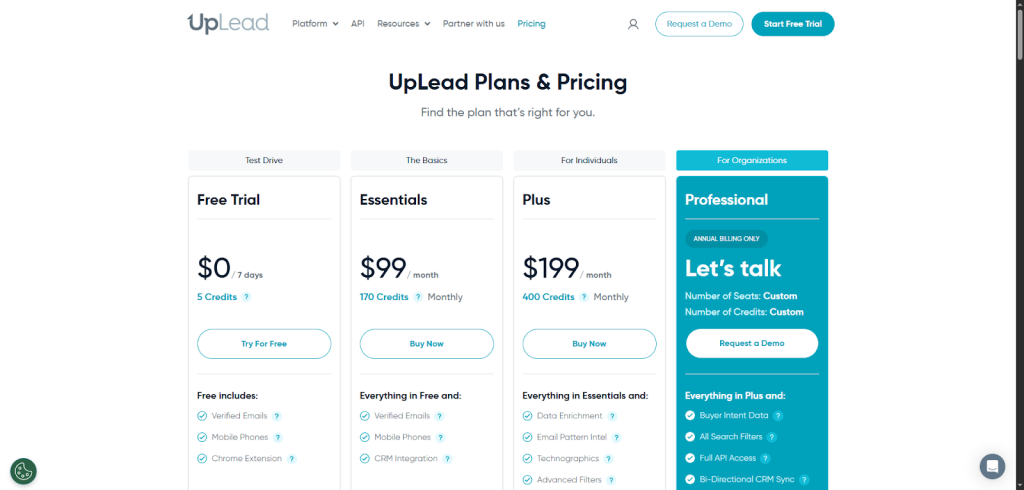
You can start with a free trial, which gives you limited credits. Perfect if you want to test the waters without any risk. Then, their paid plans kick off at $99 per month with the Essentials package.
This gives you 170 credits, which you use to download contacts or enrich data.
Next up is the Plus plan at $199 per month. Here you get 400 credits, plus enrichment and more filtering options – handy if you’re diving deeper into targeted outreach. If your needs grow, UpLead offers a Professional tier with customizable pricing. This one gives you dedicated account managers and flexible billing options, either monthly or yearly.
A nice bonus: UpLead allows limited credit rollovers, so you don’t lose them if you don’t use all your credits in a month.
ZoomInfo = enterprise-level pricing built for big teams
Contrast that with ZoomInfo, and you’ll notice a big difference in transparency.
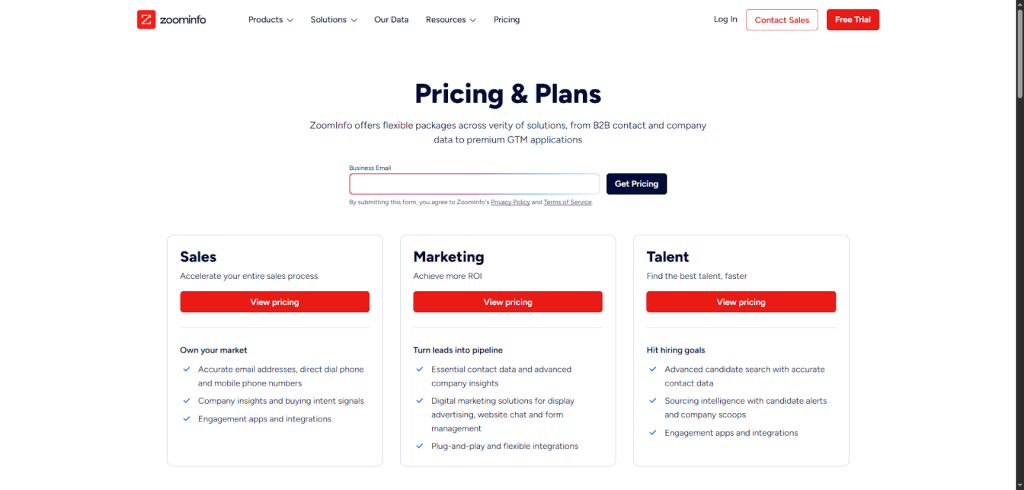
ZoomInfo doesn’t list prices publicly. Instead, they provide custom quotes based on your business size and needs. Their starting point is around $14,995 a year, which covers about 5,000 bulk credits. This plan is definitely aimed at bigger businesses or those ready to make a solid investment.
Advanced plans can climb north of $40,000 per year, and multi-year contracts are pretty common. Credits are charged for each contact or data export. Plus, ZoomInfo offers several add-ons (like intent data, technographics, and enrichment), that add to your cost. This premium bespoke pricing model means you get highly tailored services but at a significant price and commitment.
So, if your budget is tight or you want to stay agile, that long-term contract could be a dealbreaker.
Here’s a quick look at UpLead vs. ZoomInfo pricing (+ Generect) features:
| Pricing factor | UpLead | ZoomInfo | Generect |
| Starting price | $99/month (170 credits) | ~$14,995/year (approx. 5,000 credits) | No subscription; pay-as-you-go |
| Pricing transparency | Fully transparent, published pricing | No public pricing; custom quotes | Fully transparent, simple per-unit pricing |
| Contract requirements | Monthly or yearly; flexible | Multi-year contracts common | No contracts; zero commitment |
| Credit model | Credit-based; limited rollover | Credit-based with add-ons | Pay per verified email/export (no credits) |
| Cost per lead (Approx.) | Moderate, depends on tier | High, enterprise-level cost | Ultra-low: $0.03 per valid email, $0.02 per export |
| Tiers & plans | Essentials, Plus ($199/mo), Professional tiers | Multiple add-ons; intent/tech data at higher tiers | No tiers; usage-based |
| Included features at base price | Search + limited enrichment | Core data only; automation/intent add-ons | Free unlimited searches; pay only when you extract |
| Free trial / credits | No free credits; trial available | Rare depending on rep | Free $5 onboarding credit |
| Billing options | Monthly or annual | Annual (most), multi-year | Wallet top-ups starting at $20 |
| Best for | SMBs, growing teams, predictable budgets | Enterprises with high-volume needs | Startups, lean teams, and cost-efficient scaling |
If you’re looking for something even more flexible, Generect offers a unique pay-as-you-go pricing model. There’s no monthly fee or contract to lock you in. You get free searches always included, with costs of $0.03 per valid email found and $0.02 per export.
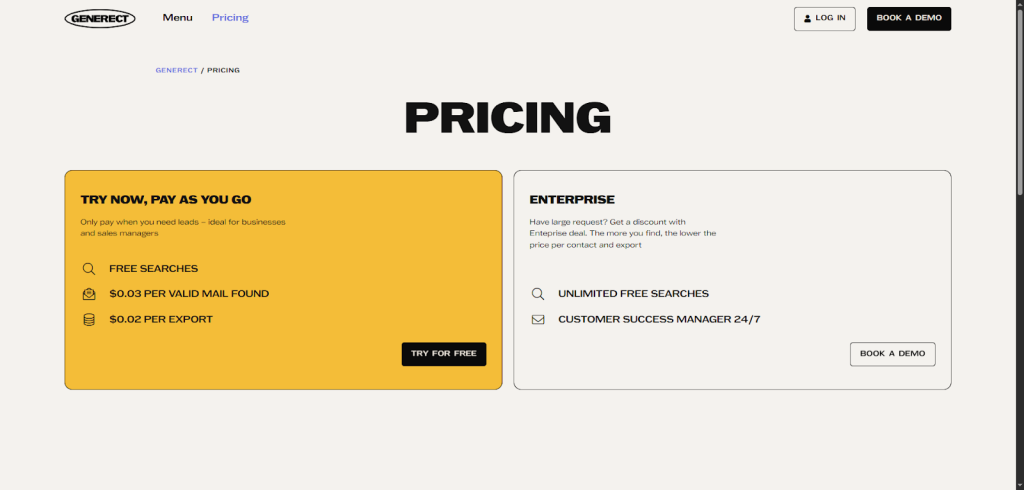
When you sign up, there’s a free $5 onboarding grant to get you started. Wallet top-ups begin at just $20, so you can scale usage exactly as you need. No more, no less.
This setup is perfect if you want to avoid subscription risks and only pay for what you actually use. Plus, Generect provides 24/7 customer success and offers enterprise discounts for bigger volumes. If you’re curious to see how this works in real time, you can explore Generect’s pricing details in their user-friendly guide online.
Price is one thing, but the real magic happens when your tools talk to each other. Here’s how each platform connects with your CRM and sales stack—and what that means for your workflow.
Ditch subscriptions. Keep the results.
Tired of being locked into annual plans? Generect lets you top up whenever you need—starting at just $20.
How do integrations differ between ZoomInfo, UpLead, and Generect?
When it comes to connecting your lead sources to your CRM and marketing tools, ease and flexibility are key. You want integrations that just work. No headaches, no endless setup calls.
Here’s how ZoomInfo, UpLead, and Generect stack up on this crucial front.
UpLead = fast, no-fuss integrations that just work
UpLead keeps it straightforward and fast. If you’re running Salesforce, HubSpot, Zoho, Pipedrive, or Microsoft Dynamics, you’re covered right out of the box. You get direct integrations that are easy to set up. No need for extra technical muscle.
Plus, UpLead hooks into over 1500 apps via Zapier, making it a breeze to connect with tools beyond your core CRM.
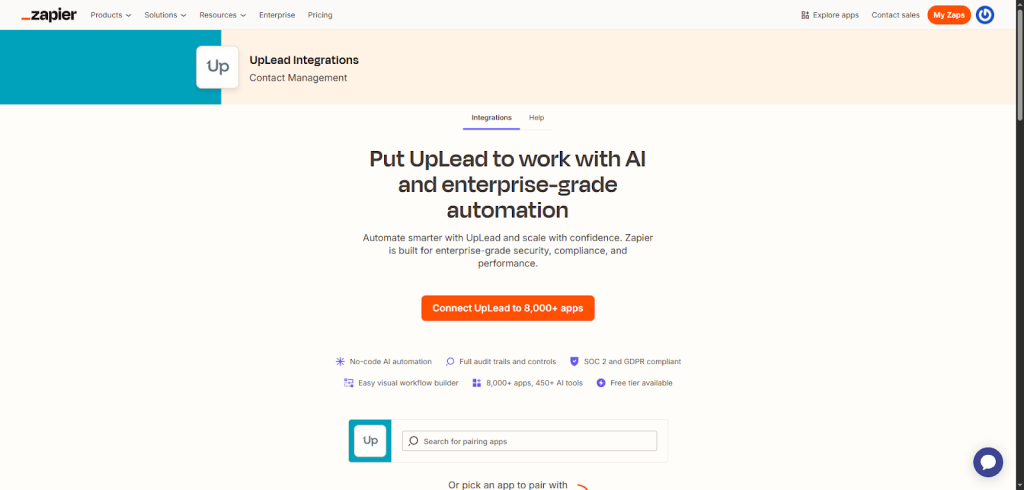
Don’t overlook their API and webhook support, which means you can sync lead data in real-time, keeping your sales and marketing teams instantly updated without manual uploads or delays.
Here’s what makes UpLead stand out:
- Quick setup with popular CRMs
- 1500+ app connections through Zapier
- API and webhook support for real-time data sync
- Out-of-the-box workflows ready to go
ZoomInfo = deep enterprise integrations for complex workflows
Contrast that with ZoomInfo, which plays at the enterprise level. Their integrations are deeper and broader, covering not only major CRMs but also revenue operations tools like Clari, marketing platforms such as Marketo and Eloqua, and email engagement tools like Outreach and SalesLoft.
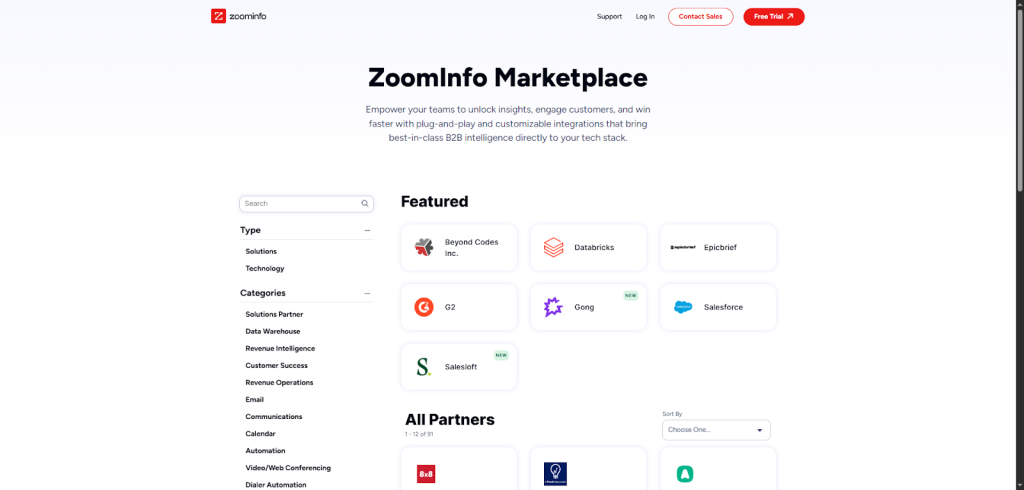
ZoomInfo’s app marketplace is extensive, offering automation-friendly workflows that are embedded right inside your CRM.
This means you’re not just pushing data. You’re streamlining your sales and marketing processes in one place.
You might find the setup a bit more complex here, and onboarding often requires dedicated support. That said, ZoomInfo’s unified integration platform and robust API enable highly customized workflows tailored to complex business needs.
For example, if your revenue ops team relies heavily on multi-step automation, ZoomInfo can handle that elegantly, albeit with a bit more upfront work.
Generect = plug-and-play API built for agile, modern teams
In the middle of this integration landscape, Generect offers something refreshingly flexible and startup-friendly. Their API+MCP is built for plug-and-play, making it easy to integrate with most CRMs and sales engagement tools you’re already using.
It supports real-time lead data pushes and enrichment without heavy IT overhead.
Generect also taps into Zapier’s wide app support for over 1500 compatible tools, so no-code workflows are totally within reach.
What sets Generect apart is their pay-as-you-go pricing model. This cuts down contract risks and lets you scale campaigns quickly, making it a perfect fit for startups and lead generation for digital marketing agencies that want to stay agile.
So, here’s a quick look at what each platform brings to your integration table:
- UpLead → simple, direct CRM integrations + extensive Zapier support + quick, no-fuss setup
- ZoomInfo → enterprise-grade, deep integrations + broad marketing and revenue ops connections + powerful but more complex
- Generect → easy plug-and-play API + real-time lead sync + flexible Zapier workflows + pay-as-you-go scaling
Price is one thing, but the real magic happens when your tools talk to each other. Here’s how each platform connects with your CRM and sales stack—and what that means for your workflow.
Your CRM will love this (so will you)
Generect pushes verified leads straight into your tools in real time—no IT team, no delays, no friction.
Which is best for your business in 2026?
Choosing the right lead source isn’t a one-size-fits-all decision.
I’ve tested plenty of tools that looked impressive upfront but slowed me down in practice. ZoomInfo is powerful and packed with data, but it’s built for big teams with big budgets. UpLead is clean, simple, reliable – great if you want accurate lists without the complexity.
But the one that surprised me most was Generect.
The real-time verification, the speed, and especially the pay-as-you-go model felt incredibly freeing. No contracts, no wasted credits. Just leads that were either valid or I didn’t pay for. For lean teams, founders, or agencies, that flexibility can be a huge advantage.
Here’s what helped me choose:
- Test each tool with your real ICP.
- Make sure it syncs smoothly with your CRM.
- Read the contract details (seriously!).
In the end, the best platform is the one that fits how you work. If you want fresh leads without long commitments, Generect is absolutely worth a try, especially with the free $5 onboarding credit.
A quick test run is usually all it takes to see the difference.

