
Best ZoomInfo Alternatives for B2B Data in 2026
Compare ZoomInfo alternatives by data workflow, CRM fit, pricing model and limitations. See when Apollo, Cognism, Clay, Lusha or Generect fits.
 10 min read
Short answer: the best ZoomInfo alternative depends on the job you need to replace. Choose Apollo for a database plus sequencing, Cognism for EMEA phone-first prospecting, Clay for multi-provider enrichment workflows, Lusha for fast rep-led lookups and Generect for API-first lead search, enrichment and verified work-email discovery with pay-as-you-go pricing. Generect is not a replacement for ZoomInfo intent or conversation intelligence. Test finalists on the same 200 representative records and compare required-field match rate, correct title and company, verified-email yield, latency and cost per usable record.
Generect publishes this page and appears in the comparison. Vendor scope and buying models were checked against each vendor’s official pricing pages and documentation on 16 November 2026. This edition does not report a cross-vendor benchmark; the bake-off method below is how you can run one on your own data.
What are the best alternatives to ZoomInfo?
ZoomInfo is a platform, not a single feature. Teams usually look for an alternative because they use only one or two parts of it (contact data, enrichment or prospecting) and the contract covers much more. The useful question is not “which vendor has the biggest database” but “which job am I replacing”. The table below maps the five most common replacement jobs to the provider that fits each one, with a buying model and an honest limitation for every row.
| Provider | Best fit | Buying model | Search/enrich model | CRM path | Honest limitation |
|---|---|---|---|---|---|
| Generect | API-first lead/company search, enrichment and verified work email | Pay as you go | Database and real-time endpoints | HubSpot app plus API | No native sequencing, intent or conversation intelligence |
| Apollo | Database plus sequencing | Subscription and credits | Vendor database | Native CRM integrations | Test verified-contact yield and credit use on the target ICP |
| Cognism | EMEA phone-first prospecting | Sales-led contract | Vendor database | Native CRM integrations | Quote-based pricing and country-level coverage vary |
| Clay | Multi-provider enrichment orchestration | Usage credits plus provider costs | Waterfall workflow | CRM workflows | Setup, provider spend and latency require active management |
| Lusha | Fast rep-led contact lookup | Free and paid credits | Vendor database | Browser/CRM workflow | Test depth and credit cost per usable record |
| ZoomInfo | Enterprise sales intelligence, intent and conversation intelligence | Enterprise/custom plus credits | Vendor database and platform | Broad enterprise ecosystem | Cost and platform breadth can exceed an API-first use case |
If you are still deciding which kind of data vendor you need at all, start with our broader guide to B2B data providers for lead generation. If the job is keeping CRM records complete, the guide to choosing a data enrichment API for your CRM goes deeper on overwrite rules, waterfalls and HubSpot.
ZoomInfo alternatives compared by buyer job
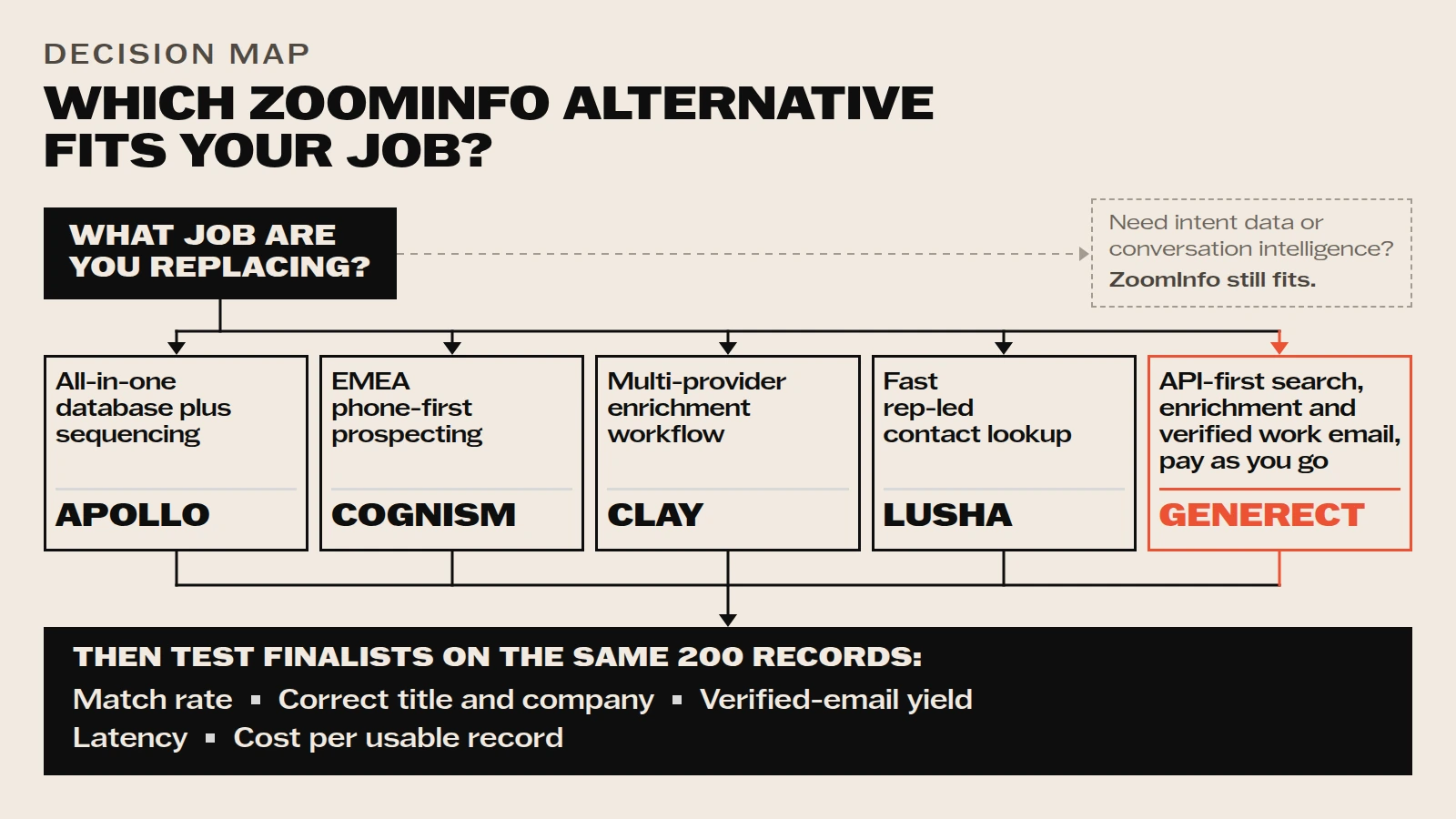
Each alternative wins a different job. Read the one that matches the part of ZoomInfo you actually use.
Apollo: database plus sequencing in one product
Apollo combines a contact database with email sequencing, a dialer and deal tools. It fits teams that want to find a contact and send the first message without leaving one product. Apollo sells plans per account (Free, Basic, Professional and Custom) with credit limits. What to test: verified-contact yield in your exact segment and how fast credits run down when you export or reveal contacts at volume.
Cognism: EMEA phone-first prospecting
Cognism positions itself on European coverage, compliance documentation and mobile numbers, with on-demand mobile verification on its higher plan. It fits outbound teams that call into the UK, DACH, France or the Nordics. Pricing is sales-led (both plans start with “talk to sales”). What to test: mobile coverage country by country, because headline coverage often hides large gaps between markets.
Clay: multi-provider enrichment workflows
Clay is an orchestration layer rather than a single database. It lets you chain several data providers in a waterfall: if provider A misses a field, provider B tries next. It fits RevOps and growth teams that want the highest possible fill rate and can manage a workflow. What to test: the match-rate lift from each extra provider against the extra spend and latency it adds.
Lusha: fast rep-led contact lookup
Lusha is built around a browser extension and a simple credit balance, with a permanent free plan and self-serve paid tiers. It fits individual reps who need a phone number or email while looking at a LinkedIn profile or CRM record. What to test: depth beyond email and phone, and the real credit cost per usable record once reveals are counted.
Generect: API-first lead search, enrichment and verified work email
Generect is a B2B lead and company data API. It fits teams that want to put search, enrichment and work-email discovery inside their own product, CRM workflow or AI agent and pay per returned result instead of per seat. It does not send email, score intent or record calls. The next two sections spell out exactly when it fits and when it does not.
ZoomInfo: when staying is the right call
If your team relies on ZoomInfo intent signals, conversation intelligence, website visitor identification and a broad set of enterprise integrations together, a single alternative rarely replaces all of it. In that case, compare renewal terms and seat counts rather than switching vendors. Our ZoomInfo API guide covers access, limits and pricing for teams that stay on ZoomInfo and only need programmatic access.
Head-to-head comparisons for specific pairs: ZoomInfo vs Apollo, Cognism vs ZoomInfo and Lusha vs ZoomInfo.
When Generect is the better fit
Generect is the better ZoomInfo alternative when the job is programmatic: you need lead and company data inside your own systems, you want to choose per call between fast cached data and fresh data and you want every charge to be visible in the response. Everything below comes from Generect’s public OpenAPI specification and pricing contract.
Two modes, one API. Database (cached) search returns results in under one second; real-time search goes to live sources and is documented at 5–60 seconds per request. You pick the mode per call. The database vs real-time guide explains when each one is worth it.
| Job | Endpoint | Standard price |
|---|---|---|
| Search leads (cached) | POST /api/v1/search/database/leads/ |
$0.02 per returned result; thin rows free up to the daily quota |
| Search leads (real-time) | POST /api/v1/search/realtime/leads/ |
$0.04 per returned result |
| Enrich a lead (cached) | POST /api/v1/enrich/database/lead/ |
$0.02 per returned result |
| Enrich a lead (real-time) | POST /api/v1/enrich/realtime/lead/ |
$0.04 per returned result |
| Find a work email | POST /api/v1/email/find/ |
$0.02 per valid email found |
| Validate an email | POST /api/v1/email/validate/ |
$0.005 per email checked |
| Find a phone number | POST /api/v1/phone/find/ |
$0.40 per phone found |
| Count a database audience | POST /api/v1/search/database/leads/count/ |
Free |
No data, no charge. Search and enrich are billed per returned result. An enrich, email-find or phone-find request that finds nothing is not charged. These are the standard (Tier 0) rates; spend-based discounts apply later and your current rate is shown in billing settings.
Cost you can audit. Every response carries meta.amount_charged, the exact USD amount that call cost. During a bake-off you can sum it per vendor test instead of estimating credit burn.
Flexible email inputs. The email finder accepts a Generect lead ID, a LinkedIn URL or first name, last name and company domain. The response includes valid_email, result, catch_all, source, email_format and mx_domain, so you can see why an address was or was not returned.
CRM path. Generect for HubSpot adds contact and company record cards and, on HubSpot Professional and Enterprise, workflow actions for Enrich contact, Enrich company, Find work email and Find phone. It fills empty fields by default, supports a daily spend cap and skips records enriched in the last 30 days unless you refresh them. The app is in early access and not yet listed in the HubSpot App Marketplace.
Moving off ZoomInfo. The migration guide maps Apollo, Hunter and ZoomInfo calls to their Generect equivalents. Live per-unit prices are also on the Generect pricing page.
When Generect is not the better fit
Pick a different alternative (or stay on ZoomInfo) if any of these describe your team:
- You need sequencing in the same tool. Generect has no built-in email sequencer or dialer. Apollo bundles both; otherwise pair Generect with your existing sending tool.
- You buy on intent data. Generect does not offer a native intent-data product. ZoomInfo, Cognism Pro and dedicated intent vendors cover that job.
- You use conversation intelligence. Generect does not record or analyse calls.
- Your reps want a point-and-click extension, not an API. Lusha or Apollo will be faster to roll out to a sales floor than an API integration.
- You want a multi-vendor waterfall managed for you. Clay is the orchestration layer. Generect is a data API, not a workflow tool for chaining other vendors.
How to run a 200-record vendor bake-off
Vendor demos run on the vendor’s best data. A fair decision uses yours, held constant across every finalist.
- Build the sample. Pull 200 records that represent your real ICP: the countries, seniority levels, company sizes and industries you sell to. Include some hard cases (recent job changers, small companies, non-English names).
- Write the answer key. For 50 of the records, confirm the correct current title, company and work email by hand. This is your accuracy check.
- Define “usable”. Decide which fields a record must have before your team can act on it, for example verified work email plus current title plus company domain.
- Run every finalist on the same 200 records in the same week, through the same path you will use in production (API, CRM app or extension).
- Measure five things: required-field match rate, correct title and company against the answer key, verified-email yield, latency per record and total cost.
- Compute cost per usable record: total cost divided by the number of records that met your “usable” definition. For Generect, total cost is the sum of
meta.amount_chargedacross the test calls. - Decide on the job, not the logo. The winner for enrichment may differ from the winner for prospecting. Many teams keep two vendors for two jobs.
Frequently Asked Questions
It depends on the job you are replacing. Apollo fits database plus sequencing, Cognism fits EMEA phone-first prospecting, Clay fits multi-provider enrichment, Lusha fits fast rep-led lookups and Generect fits API-first lead search, enrichment and verified work email with pay-as-you-go pricing. Test finalists on the same 200 records before you choose.
Yes, for API-first lead and company search, enrichment, work-email finding and phone finding. Generect is not a replacement for ZoomInfo intent data, conversation intelligence or built-in sequencing.
Use your CRM’s native enrichment for simple field completion, Clay for a multi-provider waterfall and Generect for API-first enrichment with observable per-result billing. Generect for HubSpot adds record cards and workflow actions that fill empty fields by default; it is in early access.
Generect is pay as you go with no seat fee: $0.02 per database result, $0.04 per real-time result, $0.02 per valid email found and $0.005 per email validation at the standard rate. Not-found enrich, email-find and phone-find results are not charged. Apollo, Lusha and Clay sell plans with credits; Cognism and ZoomInfo are sales-led.
Run the same 200 representative records through every finalist and measure required-field match rate, correct title and company, verified-email yield, latency and cost per usable record. Database size and vendor-reported accuracy do not show whether a provider covers your ICP.
No. Generect provides lead and company search, enrichment, email finding and validation and phone finding through an API, a HubSpot app and an MCP server. Pair it with your own sequencing tool, and use a dedicated intent vendor if intent data drives your targeting.
Choose by job, then test
No single tool replaces all of ZoomInfo for every team. Name the job you are replacing, shortlist two or three providers that fit it and let a fixed 200-record test decide. If that job is API-first lead search, enrichment or verified work-email discovery, create a free Generect account, size your audience with the free database count and run the bake-off on your own records.