


TL;DR: The best ZoomInfo alternative depends on the job you are replacing. Apollo is the closest all-in-one database-plus-outreach option; Cognism is a common EMEA phone-data shortlist; Clay orchestrates several providers; Lusha supports lightweight rep-led lookup; People Data Labs fits developer-owned pipelines; and Generect fits API-first lead search, enrichment, and verified work-email discovery.
Do not buy from a feature checklist alone. Run the same 200 representative records through each finalist and compare valid emails, working direct dials, correct titles and companies, required-field coverage, workflow time, and cost per usable result.
What are the best alternatives to ZoomInfo?
The strongest ZoomInfo alternatives are Apollo for an all-in-one database and outreach workflow, Cognism for EMEA-focused phone prospecting, Clay for multi-provider enrichment, Lusha for rep-led contact lookup, People Data Labs for developer-led data pipelines, and Generect for API-first lead search, enrichment, and verified work-email discovery. None is a universal replacement: shortlist by the ZoomInfo capability you actually use.
| Alternative | Best fit to test | Buying model | Key boundary to validate |
|---|---|---|---|
| Apollo | Database plus sequencing in one product | Subscription and credits | Coverage and verified-contact yield for your ICP |
| Cognism | EMEA phone-first workflows | Sales-led contract | Country-level mobile coverage and contract fit |
| Clay | Custom enrichment waterfalls | Usage-based credits | Setup effort, provider spend, and workflow latency |
| Lusha | Fast rep-led email and phone lookup | Free and paid tiers | Depth and credits per usable contact |
| People Data Labs | Custom applications and data pipelines | Usage-based API plans | Engineering effort and required-field coverage |
| Generect | API-first search, enrichment, email finding, and validation | Pay as you go: free searches, $0.02 per export, $0.03 per valid email | Match rate and latency; no intent or conversation-intelligence suite |
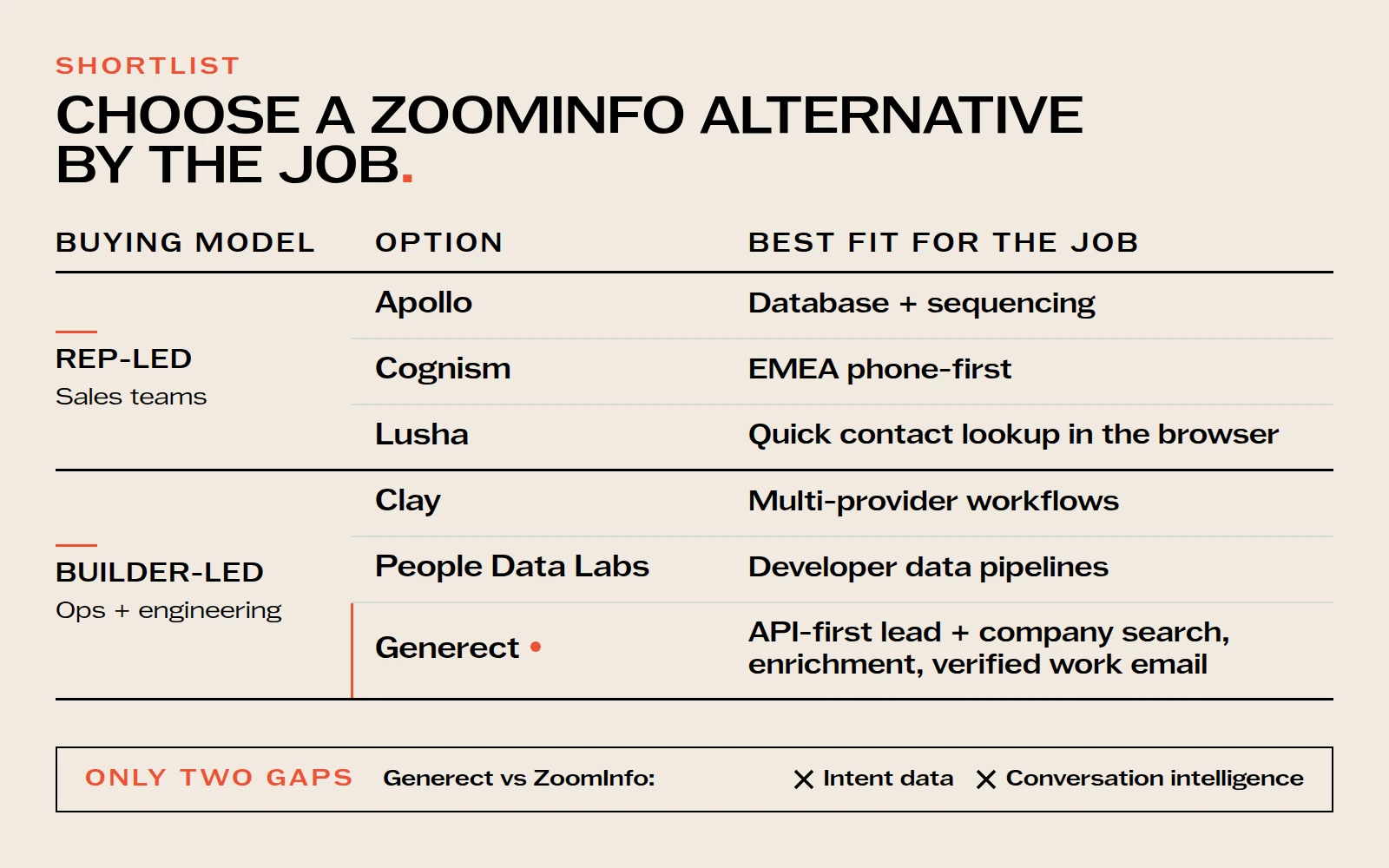
Generect’s public migration guide covers teams moving from ZoomInfo, Apollo or Hunter, while its API reference exposes separate real-time lead search, enrichment, and verified work-email finder endpoints. That makes it comparable on observable workflow coverage; it does not imply parity with ZoomInfo’s intent or conversation-intelligence products.
Before replacing ZoomInfo, test 200 representative records and calculate valid emails, working direct dials, correct titles/companies, missing required fields, workflow time, and cost per usable record. Compare with our guides to B2B data providers, data enrichment APIs, and email finder APIs.
What Is the ZoomInfo API?
The ZoomInfo API is your programmatic access to one of the largest B2B data platforms in the market: over 300 million professional contacts at 100+ million companies. Instead of logging into ZoomInfo’s UI to export CSV files, you integrate the API directly into your CRM, data pipeline or product.
In practice, it does four things:
- Search and discover → Query by job title, location, industry, tech stack or intent signals. Get structured results in JSON. Want CFOs at mid-market SaaS companies in New York who are actively researching CRM tools? The Search API handles it.
- Enrich your contacts → Already have an email or domain? The Enrich API fills in the blanks: names, direct dials, mobile numbers, job titles, seniority, company size, revenue, tech stack. A half-finished lead list becomes a complete profile.
- Bulk operations → Need to enrich 500,000 CRM records in a batch? The Bulk API handles asynchronous processing so you can submit a job and retrieve results without managing rate limits record by record.
- Website visitor identification → The WebSights API identifies anonymous company visitors to your website and links them to ZoomInfo profiles, useful for ABM campaigns and real-time sales alerts.
The API responses come back as JSON, designed to plug into CRM workflows (Salesforce, HubSpot, Marketo have native connectors), data pipelines or custom applications. You can do real-time enrichment of new sign-ups, nightly batch updates of existing CRM records or trigger enrichment from product events.
ZoomInfo API Families: What You Actually Get
ZoomInfo’s API offering breaks into five endpoint groups:
1. Search API
Accepts filter criteria and returns preview records: partial profiles designed to let you identify which contacts are worth enriching before committing credits. Think of it as casting a wide net cheaply, then enriching only the catches you want.
2. Enrich API
This is where credits get consumed. The Enrich API returns ZoomInfo’s full profile for a specific contact or company: emails, phones, org chart position, firmographics, technographics, intent topics. You match on an email address, LinkedIn URL or name + company combination.
3. Bulk API
Asynchronous batch processing for large-scale enrichment. Submit a job with a list of contacts or companies, ZoomInfo processes it, you retrieve results when done. Essential for CRM backfills (hundreds of thousands or millions of records) where synchronous one-at-a-time calls would take days.
4. WebSights API
Identifies anonymous website visitors and links them to company (and sometimes contact) profiles. Powers ABM features: who’s visiting your pricing page, what company is on your demo-request page, which intent-based accounts are engaging with your content.
5. Compliance API
Handles data privacy obligations. Lets you query ZoomInfo’s opt-out records and manage data removal requests, critical for GDPR and CCPA compliance when running outbound at scale.
Authentication and the 2026 API Platform Update
Here’s something important if you’re building a new integration in 2026: ZoomInfo is deprecating its Legacy Enterprise API. The company explicitly describes the legacy version as “in the process of being deprecated” and all new development should target the new API platform at docs.zoominfo.com.
The new platform comes with an interactive API testing playground and improved developer documentation. The core authentication model is unchanged (JWT-based), but you’ll want to build against the new endpoints from the start.
How authentication works: ZoomInfo uses JSON Web Tokens (JWTs) generated from credentials in the admin portal. The preferred method:
- Admin generates a key pair in the ZoomInfo Admin Portal (client ID + private key)
- Your application uses a JWT library to generate a token from this key pair
- Each token is valid for one hour; your service handles refresh automatically
- All API calls include the token in the Authorization header
Alternatively, you can POST username/password to an authentication endpoint and receive a short-lived JWT, simpler for testing, but the key-pair model is better for production automation because it doesn’t require storing user credentials in your infrastructure.
Why the legacy deprecation matters: If you’re evaluating a multi-year ZoomInfo contract, your team will likely need to migrate existing integrations to the new API platform during the contract term. Factor that migration effort into your TCO calculation.
Rate Limits and Throughput (2026 Numbers)
ZoomInfo operates three tiers of rate limits, which ZoomInfo published in their 2026 documentation:
| API Type | Rate Limit | Sustained Throughput |
|---|---|---|
| Authentication endpoint | 1 req/second | 60 req/minute |
| Standard APIs (Search, Enrich, WebSights, Compliance) | 25 req/second | 1,500 req/minute |
| Scaling APIs (higher-volume tier) | 33 req/second | ~2,000 req/minute |
At 25 requests per second, Standard APIs can process roughly 90,000 individual enrich calls per hour. That’s plenty for nightly CRM batch jobs. If you need real-time enrichment in a product flow (say, enriching every sign-up within 500ms), you’ll need to architect around this with caching and async processing.
Two other limits matter more than rate limits in practice:
- Request limits: total API calls allowed in your contract term
- Record limits: total records you can retrieve
These are set contractually and are the primary usage constraint for most teams. Burning through your record limit before the contract year ends is a real risk for teams that underforecast usage during procurement, and overages are expensive.
What Does the ZoomInfo API Actually Return?
When an Enrich call matches a contact, you get a structured JSON response with:
- Contact fields: email addresses, direct dials, mobile numbers, job title, department, seniority, LinkedIn URL, location
- Company fields: employee count, revenue range, industry classification, SIC/NAICS codes, company website, description, headquarters location
- Hierarchy data: parent company, subsidiary relationships, org chart positions
- Technographic data: technology stack (what CRM, marketing automation, cloud platforms the company uses)
- Intent signals: topic areas where ZoomInfo’s platform detects that this company is actively researching (available on intent-enabled contracts)
A ZoomInfo Copilot workflow showcased in 2026 demonstrates this in action: drop a spreadsheet of company names into the app, the system calls the API and enriches each with 20+ data fields including headcount, revenue, funding history, CRM technographics, direct dials, and LinkedIn URLs, then returns the file with key buying committee contacts added.
ZoomInfo API Pricing in 2026: The Numbers They Don’t Publish
ZoomInfo does not publish API pricing. Their pricing pages describe credit-based consumption without specific numbers, and API access is typically bundled into enterprise contracts rather than available as a standalone product.
Here’s what third-party data and buyer communities reveal about real 2026 contract values:
| Buyer Segment | Typical Annual Cost |
|---|---|
| Small teams (1–3 seats) | $15,000–$25,000 |
| Mid-market teams (5–10 seats) | $25,000–$40,000 |
| Larger teams (25+ seats) | $40,000–$80,000+ |
| Median contract value (Vendr, 1,314 purchases) | ~$32,000 |
| Enterprise API access (standalone) | $50,000+ estimated |
The hidden cost factor: effective cost per enriched record. A 2026 independent benchmark by Cleanlist estimated ZoomInfo’s Enrich API effectively costs between $0.50 and $2.00 per record depending on contract tier. When you factor in email deliverability (85%), the effective cost per valid email delivered is approximately $0.59.
To put that in perspective:
- Apollo: ~$0.15 per valid email
- Clearbit: ~$0.29 per valid email
- Cleanlist (waterfall): ~$0.15 per valid email
- ZoomInfo: ~$0.59 per valid email
That’s roughly a 4x premium over Apollo on pure email cost. ZoomInfo wins on phone data, but if your motion is primarily email-based, you’re paying for coverage you may not use.
Watch out for:
- Auto-renewal clauses: contracts typically auto-renew unless canceled 60–90 days before expiration
- Annual price increases: teams report standard 10–20% increases at renewal, sometimes 20–40% if you’ve expanded usage
- Unused credits: credits expire at contract year end; underutilized plans waste budget
- Add-on costs: Copilot, intent data, Chorus (conversation intelligence), and ABM features are often quoted separately
Data Accuracy: 2026 Independent Benchmark Results
The most useful signal for any enrichment API is independent benchmark testing: not what the vendor claims, but what third-party tests reveal on a controlled contact set.
In a March 2026 Cleanlist benchmark of 1,000 B2B leads across five verticals, ZoomInfo’s performance:
| Metric | ZoomInfo | Apollo | Generect |
|---|---|---|---|
| Email match rate | 84% | 78% | 98% valid emails (published product claim) |
| Mobile phone match rate | 67% | 41% | 98% phone accuracy (published product claim) |
A separate 500-contact test revealed:
- Email deliverability: ~85% (75 bounces out of 500 contacts)
- Direct dial connection rate: ~80% (20% reached wrong person or were disconnected)
- Firmographic accuracy: ~92% (company size, industry classification mostly correct)
- API latency: ~1.0 second median
ZoomInfo’s phone data is genuinely strong: a 67% mobile match rate vs Apollo’s 41% is a meaningful difference if cold calling is your primary channel. For email-heavy motions, the ~15% bounce rate is manageable but requires validation tools to protect sender reputation.
The structural ceiling problem: Independent researchers describe ZoomInfo (along with Apollo and Clearbit) as a “single-database” provider. Their data is collected and refreshed periodically from proprietary sources. This architecture structurally caps email accuracy in the 80–85% range, not because ZoomInfo doesn’t invest in quality, but because B2B contact data changes faster than any single database can update. People change jobs. Email formats shift. Domains migrate.
Waterfall providers (which query 15+ sources per lookup and verify in real time) can reach 98% verified email accuracy in the same benchmarks. More on this below.
New in 2026: Copilot, AI Workflows, and Data Expansion
ZoomInfo has made significant AI investments since 2025 that are now woven into the API ecosystem:
ZoomInfo Copilot (AI-Powered GTM Workflows)
Copilot is ZoomInfo’s AI layer built on top of its enrichment API. The clearest demonstration of its 2026 capabilities: upload a list of companies, Copilot calls the API to enrich each record with 20+ fields (headcount, revenue, funding history, technographics, direct dials, LinkedIn URLs), adds key buying committee contacts, generates AI-personalized emails for each contact, and surfaces deal risk alerts for existing pipeline.
This shifts ZoomInfo’s positioning from “data provider” to “GTM platform with data at the core.” For buyers evaluating just the enrichment API, Copilot is optional, but for teams wanting an integrated AI-assisted outbound motion, it’s a meaningful differentiator that competitors don’t offer natively.
June 2026 Data Expansion
ZoomInfo’s June 2026 data update added:
- 2.5 million new company locations added to the database
- 4.1 million existing locations verified and standardized
This matters for account-based motions: knowing a prospect’s geographic footprint (number of offices, regional hubs, headquarters) affects territory planning, SLA discussions, and localized campaigns. The update reflects ongoing investment in the account data layer that underpins the API.
ZoomInfo API vs Alternatives: 2026 Head-to-Head Comparison
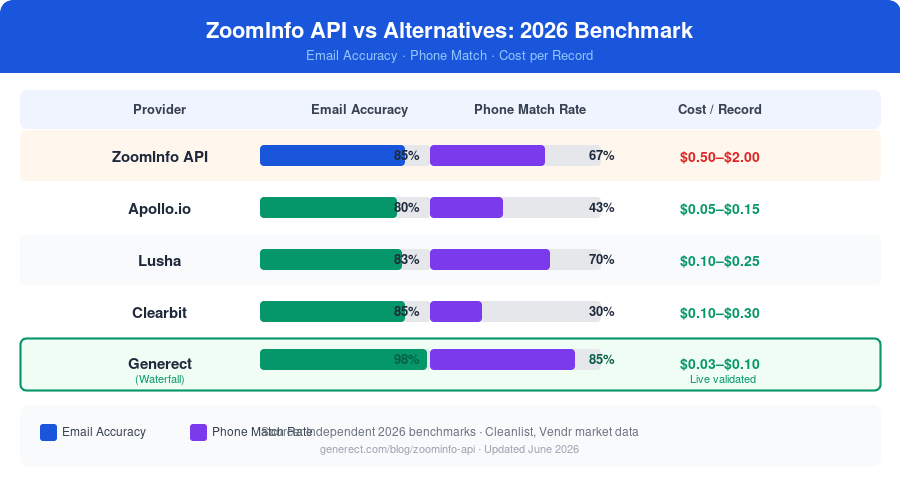
Here’s how ZoomInfo’s API stacks up against the key alternatives based on 2026 independent benchmarks:
| Provider | Email Accuracy | Phone Coverage | Avg Latency | Per-Record Cost | Architecture |
|---|---|---|---|---|---|
| ZoomInfo API | ~85% | ~60–67% | ~1.0s | $0.50–$2.00 | Single database |
| Apollo API | ~80% | ~41–45% | ~0.8s | $0.05–$0.15 | Single database |
| Clearbit (HubSpot) | ~85% | Limited | ~0.5s | $0.10–$0.30 | Single database |
| Cleanlist (waterfall) | 98% | ~85% | ~1.2s | $0.03–$0.10 | Waterfall (15+ sources) |
| People Data Labs | ~78% | ~40% | ~0.4s | $0.02–$0.08 | Single database |
| Lusha | ~83% | ~70% | ~0.6s | $0.10–$0.25 | Single database |
| Hunter (email only) | ~88% | N/A | ~0.3s | $0.01–$0.05 | Single database |
| Generect | 98% valid emails (published product claim) | 98% accuracy (published product claim) | N/A | $0.03 per valid email; $0.02 per export. See live pricing | Real-time search and verification |
Source: Cleanlist 2026 benchmark across 2,000 B2B contacts (January–March 2026).
Apollo ($49–$119/user/month)
Apollo is the most common ZoomInfo alternative for mid-market and SMB. Published pricing (unlike ZoomInfo), integrated sequences and dialer, 275M+ contact database. The email accuracy gap (80% vs 85%) is real but manageable with verification tooling. The phone gap (41% vs 67% mobile match rate) is where Apollo falls short if cold calling is critical. Real-world costs run $150–$400/user/month when credit overages and add-ons are included: much less than ZoomInfo, but higher than the headline suggests.
Clearbit by HubSpot
Best fit if you’re already deep in HubSpot. Email accuracy on par with ZoomInfo (~85%), but limited phone coverage and tightly coupled to HubSpot licensing. Roughly $0.29/valid email at ~$2,500 per 10,000 enrichments. Not suitable as a standalone enrichment API outside the HubSpot ecosystem.
People Data Labs
Developer-first, raw data, flexible API pricing with clear per-record costs and rate limit dashboards. 1.5B+ records claimed, but email accuracy (~78%) is lower than ZoomInfo. Best for data science teams building custom enrichment pipelines who want flexible, usage-based access without enterprise contracts.
Waterfall Enrichment (Cleanlist, Clay)
The architectural alternative to single-database providers. Query 15+ sources per lookup, verify email deliverability in real time, achieve 98% accuracy. The trade-off: slightly higher latency (~1.2s vs 1.0s for ZoomInfo). No intent data, no conversation intelligence, just very high-quality contact enrichment data at a fraction of ZoomInfo’s cost. For teams whose primary need is email accuracy at scale, this architecture now materially outperforms any single-database provider.
Single-Database vs Waterfall: Why Architecture Matters
This is the most important concept for evaluating ZoomInfo in 2026, and it’s one most buyers overlook.
Single-database providers (ZoomInfo, Apollo, Clearbit) maintain a proprietary database refreshed in batches from their own collection mechanisms. When you call their API, they return the current record from that database. Latency is low. But accuracy is capped by how recently any given record was updated, and B2B contacts change jobs at roughly 20–30% annually.
The structural result: email accuracy plateaus at 80–85% regardless of database size. ZoomInfo has 300M+ contacts; Apollo has 275M+. Yet their accuracy numbers in head-to-head tests are almost identical. More records don’t fix the freshness problem.
Waterfall providers query multiple sources per lookup in real time, then verify email deliverability via SMTP before returning the result. The email you get back has been checked: it exists, the inbox accepts mail. The result: 98% verified email accuracy in the same benchmarks where ZoomInfo hits 85%.
The trade-off: waterfall providers don’t bundle intent signals, conversation intelligence or AI-assisted outreach. They’re data infrastructure, not GTM platforms. If you need ZoomInfo’s full stack (enrichment + intent + WebSights + Copilot), the waterfall alternative doesn’t exist yet. But if you need high-accuracy email enrichment at scale, the architectural edge is real and the cost difference is significant.
When ZoomInfo API Is the Right Choice
ZoomInfo makes sense when:
- Cold calling is core to your motion. A 67% mobile match rate vs Apollo’s 41% can meaningfully change your connect rates. If you’re running a high-volume outbound dialing team, ZoomInfo’s phone data advantage compounds across thousands of calls.
- Intent data changes your targeting. ZoomInfo is the only major enrichment provider with native third-party intent signals. If timing your outreach around research activity is central to your ICP strategy, nothing else bundles this with enrichment.
- You want to consolidate your GTM stack. ZoomInfo’s integrated platform (SalesOS + enrichment API + WebSights + Copilot + Chorus) reduces the number of vendor relationships and integrations to manage. For enterprise RevOps teams, that consolidation has real operational value.
- Compliance is a high-stakes requirement. ZoomInfo’s Compliance API and enterprise-grade data governance infrastructure are mature. For companies under heavy regulatory scrutiny, working with an established vendor reduces risk.
- Budget allows. You need at least $15K/year for basic access and typically $25K–$40K for a meaningful mid-market deployment. If the budget isn’t there, alternatives deliver better value at lower spend.
When ZoomInfo API Is Overkill
ZoomInfo is the wrong choice when:
- Your motion is primarily email. You’re paying ~$0.59/valid email vs ~$0.15 for Apollo or waterfall alternatives. If email is 90%+ of your outreach and you don’t need direct dials, you’re paying a 4x premium for coverage you’re not using.
- You’re an early-stage or SMB-focused team. ZoomInfo’s minimum contract requirements and opaque pricing are built for enterprise procurement cycles. If you need to trial, iterate, and scale gradually, providers with self-serve credit-based models (Apollo, PDL, Cleanlist) are a better operational fit.
- Email deliverability is paramount. If you’re sending high-volume automated emails and a 15% bounce rate would damage your sender reputation, you need 98% verified accuracy, which single-database providers structurally cannot deliver. Use a waterfall enrichment provider as your primary source.
- You’re targeting SMB or non-US markets heavily. Independent benchmarks note that single-database providers including ZoomInfo “quietly degrade” SMB record freshness compared to enterprise contacts. Non-US coverage gaps are also more pronounced. Conduct your own tests on your ICP before committing.
CRM Integration and Workflow Patterns
ZoomInfo offers native CRM connectors for Salesforce, HubSpot, and Marketo, which handle the most common enrichment workflows without custom API integration. But teams building custom pipelines need to understand the typical API pattern:
- Search to identify: use Search API with domain or name criteria to find the right company or contact match candidates
- Match logic: apply internal heuristics (or human validation for ambiguous matches) to select the correct record
- Enrich to retrieve: call Enrich API to get the full profile for matched records (this is where credits are consumed)
- Write to CRM: map ZoomInfo fields to your CRM’s field schema and write enriched data
- Schedule refresh: set up recurring jobs to re-enrich existing CRM records quarterly or semi-annually as contacts change jobs
The Bulk API handles steps 3–4 at scale asynchronously, making it suitable for initial backfills of large CRM databases. For real-time enrichment (e.g., enriching a new sign-up the moment they submit a form), the synchronous Enrich API with caching handles most use cases within the rate limit envelope.
The Generect Alternative: Live Data vs Static Database
At Generect, we take a different approach to the data freshness problem that underlies most ZoomInfo limitations.
Instead of a periodically-refreshed static database, we pull live data from LinkedIn and Crunchbase at the time of the enrichment request and validate deliverability before returning results. The outcome:
- ~2% email bounce rate vs ZoomInfo’s 15–20% range in independent benchmarks
- Contacts reflect current job titles, not what was scraped 90 days ago
- No enterprise contract required: usage-based pricing that scales with your actual volume
The trade-off: we don’t have ZoomInfo’s intent signals or conversation intelligence. If those features are core to your motion, ZoomInfo’s integrated platform is genuinely differentiated.
But for teams primarily running email-based outbound or building enrichment into their product (where deliverability and data freshness matter more than phone coverage and intent signals), live enrichment at a fraction of ZoomInfo’s per-record cost typically delivers better ROI.
We work with 4,000+ B2B companies running exactly this kind of motion. Check out Generect if you want to compare real numbers on your ICP data before committing to a ZoomInfo contract.
ZoomInfo API Setup: The Practical Path
If you decide ZoomInfo is the right fit, here’s the realistic setup timeline:
- Sales cycle (2–6 weeks): ZoomInfo doesn’t do self-serve. You’ll go through a sales process with demos, negotiation, and procurement review. Budget this time for stakeholder alignment and getting legal to review the auto-renewal clauses.
- Admin setup (1–3 days): Once provisioned, your admin generates API keys in the Admin Portal. Test authentication, verify JWT token generation is working, confirm your credentials have access to the API families you contracted for.
- Integration development (1–4 weeks): Depends heavily on your stack. Native CRM connectors (Salesforce, HubSpot) are faster. Custom API integrations into data pipelines or products take longer, particularly if you’re building Search + Enrich flows with match logic.
- Target the new API: With the legacy Enterprise API being deprecated, build against docs.zoominfo.com endpoints from the start. Don’t build on legacy infrastructure you’ll need to migrate.
- Monitor consumption: Set up dashboards tracking request usage and record consumption against your contract limits. ZoomInfo’s credit system can deplete faster than expected when enrichment is automated.
Common Pitfalls (What I’ve Seen Go Wrong)
After seeing how hundreds of B2B teams use enrichment APIs, here’s where ZoomInfo deployments tend to go sideways:
- Underforecast credit usage. Teams sign contracts based on initial volume estimates, then run automated workflows that deplete credits 2x faster than projected. Model worst-case scenarios before you sign.
- No email validation layer. At 85% deliverability, 15% of emails will bounce if sent cold. Don’t assume ZoomInfo’s data is clean enough to skip verification. Add an email validation step, especially if you’re sending at volume and care about deliverability scores.
- Building on the legacy API. If you’re starting a new integration in 2026, build against the new API platform. Legacy is being deprecated. Future-proof your integration now.
- Skipping the SMB/non-US test. ZoomInfo’s enterprise US database is strong. SMB coverage and international data quality are meaningfully weaker. If your ICP includes SMBs or non-US markets, test specifically on those segments before signing.
- Ignoring the renewal window. ZoomInfo’s 60–90 day cancellation notice before auto-renewal catches teams off guard. Mark the calendar the day you sign.
Verdict: Is ZoomInfo API Worth It in 2026?
ZoomInfo’s API is genuinely excellent at what it’s designed for: enterprise B2B data enrichment with strong phone coverage and an integrated GTM platform.
The 2026 picture:
- ~85% email accuracy, ~67% mobile match rate, ~92% firmographic accuracy from independent benchmarks
- 25–33 req/second rate limits sufficient for most CRM workflows
- $15K–$80K/year typical contract; $0.50–$2.00 effective per-record cost
- New API platform replacing legacy (build against the new endpoints)
- Copilot AI features now integrated for AI-assisted outbound workflows
- June 2026 data update: 2.5M new locations, 4.1M verified
If cold calling is your primary channel, intent signals drive your targeting, and you want a consolidated platform (enrichment + intent + AI workflows + conversation intelligence), ZoomInfo earns its premium.
If you’re email-first, budget-constrained or need 98% deliverability for high-volume automated outreach, the 4x per-record cost premium over waterfall alternatives is hard to justify. Apollo at $0.15/valid email or a waterfall provider at $0.10/valid email with 98% accuracy will likely deliver better ROI on an email motion.
The most pragmatic path for most B2B SaaS teams in 2026: use ZoomInfo specifically for the accounts where phone outreach and intent timing matter (key enterprise targets), and a lower-cost email enrichment layer for broader pipeline coverage. You don’t have to pick one, and avoiding ZoomInfo’s contract minimum on your full database will likely save enough to fund both.
Ready to see how your ICP compares across enrichment providers? Run a test on Generect: no enterprise contract, no 90-day cancellation notice, and you’ll see exactly where live enrichment wins on your specific contact data.
Frequently Asked Questions
ZoomInfo doesn’t publish API pricing publicly. Based on 2026 market data: SalesOS Professional starts at approximately $15,000/year for a single user; most mid-market teams pay $25,000–$40,000/year; enterprise contracts with intent data and API access typically run $50,000–$80,000+/year. The median ZoomInfo contract across 1,314 verified purchases (Vendr, 2026) is approximately $32,000/year. Effective per-record API cost is estimated at $0.50–$2.00 depending on contract tier.
ZoomInfo’s 2026 documented rate limits: Authentication endpoint = 1 request/second. Standard APIs (Search, Enrich, WebSights, Compliance) = 25 requests/second (1,500/minute). Scaling APIs = 33 requests/second (~2,000/minute). Additionally, contracts include total request limits and record limits for the entire contract term; these contractual caps are typically more constraining than the per-second rate limits.
Independent 2026 benchmarks place ZoomInfo’s email deliverability at approximately 84–85% on U.S. B2B contacts. This means roughly 15% of emails returned by the API will bounce when sent cold. ZoomInfo outperforms Apollo (78%) on email and significantly outperforms on phone data (67% mobile match vs Apollo’s 41%). However, waterfall enrichment providers (which verify deliverability in real time across 15+ sources) can achieve 98% email accuracy in the same benchmarks.
No. ZoomInfo does not offer a free tier or self-serve trial for API access. Access is provisioned through enterprise sales contracts. If you need to test enrichment quality on your ICP data before committing, you’ll need to negotiate a trial as part of the sales process or test with a provider that offers self-serve access (Apollo, People Data Labs, Hunter or Generect all have lower-commitment options).
Build on the new API platform at docs.zoominfo.com. ZoomInfo explicitly describes the Legacy Enterprise API as “in the process of being deprecated” as of 2026. New integrations should target the new endpoints, which come with an interactive testing playground and improved documentation. If you have existing legacy integrations, plan migration into your contract timeline.

